
BREXIT - BEFUDDLED AND BE-JUDGED!
The High Court of Justice of England and Wales has made a preliminary and sensational ruling on how Brexit must be approached. The case, in addition to being politically significant, is of course legally and constitutionally significant as the High Court did pull out all the stops knowing that that was the case, with no less than three of the most senior judges in the England and Wales jurisdiction sitting on the case; the Lord Chief Justice, the Master of the Rolls, and Lord Justice Sales. The case itself is :- The Queen on the application of (1) Gina Miller & (2) Deir Tozetti Dos Santos – and – The Secretary of State for Exiting the EU. It can be found on the court website here:- https://www.judiciary.gov.uk/wp-content/uploads/2016/11/judgment-r-miller-v-secretary-of-state-for-exiting-the-eu-20161103.pdf
The case is worth reading if you are at all interested in the law of Constitution.
There is however a potted summary here for those less interested in legal details >>>
https://www.judiciary.gov.uk/wp-content/uploads/2016/11/summary-r-miller-v-secretary-of-state-for-exiting-the-eu-20161103.pdf
Here is the text of the Summary:-
“R (Miller) v Secretary of State for Exiting the European Union
Summary of the judgment of the Divisional Court
References in square brackets are to paragraphs in the judgment.
The Question
1. The issue before the court is whether, as a matter of UK constitutional law, the Government is entitled to give notice of a decision to leave the European Union under Article 50 by exercise of the Crown’s prerogative powers and without reference to Parliament. This is a pure question of law. The court is not concerned with and does not express any view about the merits of leaving the European Union: that is a political issue.
2. It is accepted by all sides that this legal question is properly before the court and justiciable: under the UK constitution, it is one for the court to decide [5]. It turns on the extent of the Crown’s powers under its prerogative [explained at 24-29]. The Government accepts that neither the European Union Referendum Act 2015 nor any other Act of Parliament confers on it statutory authority (as distinct from the Crown’s prerogative power) to give notice under Article 50 [67-72, 76 and 105-108].
3. On 1 January 1973 the United Kingdom joined what were then the European Communities, including the European Economic Community. Parliament passed the European Communities Act 1973 (1972 Act) to allow that to happen since it was a condition of membership that Community law should be given effect in the domestic law of the United Kingdom and primary legislation was required to achieve this [1 and 36-54]. The European Communities have now become the European Union.
4. Pursuant to the European Union Referendum Act 2015 a referendum was held on 23 June 2016 on the question whether the United Kingdom should leave or remain in the European Union. The answer given was that the UK should leave [2].
5. The process for withdrawal is governed by Article 50 of the Treaty on European Union, which states that once a Member State gives notice to withdraw there is a two-year period in which to negotiate a withdrawal agreement. If no agreement is reached in this time then, subject only to agreement to an extension of time with the European Council acting unanimously, the EU Treaties shall cease to apply to that State. The Government accepts that a notice under Article 50 cannot be withdrawn once it has been given. It also accepts that Article 50 does not allow a conditional notice to be given: a notice cannot be qualified by stating that Parliament is required to approve any withdrawal agreement made in the course of Article 50 negotiations [9-17].
6. Therefore, once notice is given under Article 50, some rights under EU law as incorporated into domestic law by the 1972 Act would inevitably be lost once the Article 50 withdrawal process is completed [57-66].
The Constitutional principles
7. The most fundamental rule of the UK’s constitution is that Parliament is sovereign and can make and unmake any law it chooses. As an aspect of the sovereignty of Parliament it has been established for hundreds of years that the Crown – i.e. the Government of the day – cannot by exercise of prerogative powers override legislation enacted by Parliament. This principle is of critical importance and sets the context for the general rule on which the Government seeks to rely – that normally the conduct of international relations and the making and unmaking of treaties are taken to be matters falling within the scope of the Crown’s prerogative powers. That general rule exists precisely because the exercise of such prerogative powers has not effect on domestic law, including as laid down by Parliament in legislation [18-36].
8. In the present case, however, the Government accepts, and indeed positively contends, that if notice is given under Article 50 it will inevitably have the effect of changing domestic law. Those elements of EU law which Parliament has made part of domestic law by enactment of the 1972 Act will in due course cease to have effect [76-80].
9. The central contention of the Government in the present case is that Parliament must be taken to have intended when it enacted the 1972 Act that the Crown would retain its prerogative power to effect a withdrawal from the Community Treaties (now the EU Treaties), and thereby intended that the Crown should have the power to choose whether EU law should continue to have effect in the domestic law of the UK or not [76-81].
Conclusion
10. The Court does not accept the argument put forward by the Government. There is nothing in the text of the 1972 Act to support it. In the judgment of the Court the argument is contrary both to the language used by Parliament in the 1972 Act and to the fundamental constitutional principles of the sovereignty of Parliament and the absence of any entitlement on the part of the Crown to change domestic law by the exercise of its prerogative powers [82-94, 97-104]. The Court expressly accepts the principal argument of the claimants [95-96].
11. For the reasons set out in the judgment, we decide that the Government does not have power under the Crown’s prerogative to give notice pursuant to Article 50 for the UK to withdraw from the European Union.
This summary is provided to assist in understanding the Court’s decision. It does not form part of the reasons for the decision. The full judgment of the Court is the only authoritative document.”
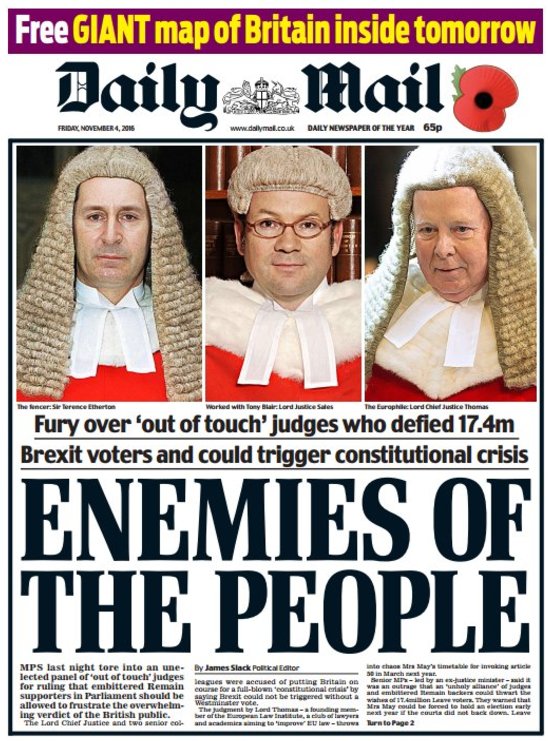
Following the release of this Judgment there has been an attack on the political and demographic origins of the three Judges, all three of whom are the product of Labour’s Lord Derry Irvine “Reforms” to the selection and promotion of the judiciary. Lord Irvine expressly said these had been engineered to “ensure that no-one with reactionary views could be appointed or promoted within the judiciary”. This expressed objective has clearly been achieved with these three judges. The
Lord Chief Justice background as an active Europhile was amply exposed in the Daily Mail article here >>> http://www.dailymail.co.uk/news/article-3903436/Enemies-people-Fury-touch-judges-defied-17-4m-Brexit-voters-trigger-constitutional-crisis.html
In the original version of the article, the Daily Mail also reported the Master of the Rolls, Sir Terence Etherton as being the first “openly gay” senior Judge and also as having married his boyfriend in “a traditional Jewish marriage ceremony”.
Lord Justice Sales was exposed as being one of Lord Irvine’s personal protégées.
So it appears that we can be reasonably confident of the personal views and political prejudices of all three judges!
From a lawyer’s point of view there was therefore, particularly with the Lord Chief Justice, good grounds for applying the approach which was adopted by the House of Lords in the Pinochet case to Lord Hoffman who had ruled based on his own political prejudices. The case can be found here>>> http://www.publications.parliament.uk/pa/ld199899/ldjudgmt/jd990115/pino01.htm
The most extraordinary aspect of this fiasco is that any reasonably competent country solicitor would have advised the Government that where a challenge was being made to legal rights to take action (in this case the Government giving notice under Article 50 of the Lisbon Treaty) the obvious thing to do is to get on with it and give the Notice.
This of course would have made it pointless continuing with the court case. The Notice would already have been accepted by the European Union and the process of leaving the EU would therefore be underway regardless of what any court had to say. In such cases the courts are very unwilling to give rulings on what are described as “moot points”. It follows that the fiasco is a product of delay and incompetence within the May Government.
Turning back to the Judgment, it is a Judgment that is more dubious on previous legal authority than it sounds as it is phrased in what has been described as “muscular” language. I would also respectfully suggest it seems to be over certain of its legal position. This is however partly a result of the incompetence of the Attorney General in agreeing that the case was “justiciable”.
As an example of arguments that show that the Judgment is more dubious than it seems, see here for an academic analysis >>> https://publiclawforeveryone.com/2016/11/04/the-high-courts-judgment-in-miller-a-brief-comment/
Here is the text of the article:-
“The High Court’s judgment in Miller: A brief comment
The following short comment on the High Court’s judgment in R (Miller) v Secretary of State for Exiting the European Union [2016] EWHC 2768 (Admin) was published on the Judicial Power Project’s website and is reproduced here with permission. The piece is part of a collection of short commentaries published by the Judicial Power Project; the full collection can be accessed here. I will be publishing a more detailed piece on Miller in due course.
Some of today’s press coverage of the judgment in Miller, accusing judges of acting undemocratically, is deplorable. It is entirely right and proper that the Court should determine the legal extent of executive authority. That is an axiomatic judicial function in a democracy founded on the rule of law. But what of the content of the decision?
The judgment is striking in its muscularity. The Court considered the Government case to be so weak that it judged it untenable before even considering the claimant’s arguments in detail. The Government’s case, said the Court, was ‘flawed’ at a ‘basic level’. Reading the judgment, one might be forgiven for thinking that the Government had advanced a heterodox argument of outlandish proportions. In fact, it was simply asserting that it could use a prerogative power to begin negotiations on the international plane. None of this is to deny the subtlety of the issues to which that contention gives rise concerning the relationship between EU and domestic law, and the role played by the European Communities Act 1972 in mediating that relationship. But as John Finnis has shown, the Government’s position is far from unarguable.
Once the Divisional Court had accepted — contrary to Finnis’s view — that EU law rights are to be considered domestic statutory rights enacted by Parliament, its focus inevitably shifted to the question whether the ECA was to be read as having displaced the Government’s ability to use the prerogative to begin the Article 50 process. In concluding that the ECA had indeed produced such an effect, the Court engaged in a highly creative process of statutory interpretation that involved relying upon the ECA’s status as a ‘constitutional statute’; treating the Act’s ‘constitutional status’ as evidence of Parliament’s intention — a view that is in tension with Laws LJ’s analysis in Thoburn; invoking certain ‘background constitutional principles’ that are relevant to statutory interpretation; and asserting that those principles are particularly relevant to the construction of constitutional statutes.
My point, in this short comment, is not to assess the correctness of the court’s conclusion on this matter. Rather, it is to observe that that conclusion — and the reasoning on which it is based — is highly contestable. Perhaps, therefore, the most surprising aspect of Miller is that the confident certainty of the terms in which the judgment is framed obscures almost entirely the complexity and contestability of the questions to which it gives rise, concerning the selection, content and interaction of the constitutional principles that form the prism through which the ECA falls to be examined.”
The core of the Judgment is that the central institution within the Constitution is the Crown in Parliament. Here is a section of the Judgment well worth quoting and bearing in mind.
“ The principles of constitutional law: the sovereignty of Parliament and the prerogative powers of the Crown
The United Kingdom constitution
18. The United Kingdom does not have a constitution to be found entirely in a written document. This does not mean there is an absence of a constitution or constitutional law. On the contrary, the United Kingdom has its own form of constitutional law, as recognised in each of the jurisdictions of the four constituent nations. Some of it is written, in the form of statutes which have particular constitutional importance (as we explain at paragraphs 43-44). Some of it is reflected in fundamental rules of law recognised by both Parliament and the courts. There are established and well-recognised legal rules which govern the exercise of public power and which distribute decision-making authority between different entities in the state and define the extent of their respective powers. The United Kingdom is a constitutional democracy framed by legal rules and subject to the rule of law. The courts have a constitutional duty fundamental to the rule of law in a democratic state to enforce rules of constitutional law in the same way as the courts enforce other laws.
19. In these proceedings, this court is called upon to apply the constitutional law of the United Kingdom to determine whether the Crown has prerogative powers to give notice under Article 50 to trigger the process for withdrawal from the European Union. The law we were taken to was primarily the law of England and Wales, with some reference to the position in the other jurisdictions in the United Kingdom, Scotland and Northern Ireland. Although this court only has jurisdiction to apply the law of England and Wales, we note that no-one in these proceedings has suggested that such parts of constitutional law in Scotland and Northern Ireland in relation to the interaction between statute and the Crown’s prerogative powers as are relevant to determine the outcome in this case are any different from the law of England and Wales on that topic. Accordingly, for ease of reference and in view of the general constitutional importance of this case we will refer to UK constitutional law.
The sovereignty of the United Kingdom Parliament
20. It is common ground that the most fundamental rule of UK constitutional law is that the Crown in Parliament is sovereign and that legislation enacted by the Crown with the consent of both Houses of Parliament is supreme (we will use the familiar shorthand and refer simply to Parliament). Parliament can, by enactment of primary legislation, change the law of the land in any way it chooses. There is no superior form of law than primary legislation, save only where Parliament has itself made provision to allow that to happen. The ECA 1972, which confers precedence on EU law, is the sole example of this.
21. But even then Parliament remains sovereign and supreme, and has continuing power to remove the authority given to other law by earlier primary legislation. Put shortly, Parliament has power to repeal the ECA 1972 if it wishes.
22. In what is still the leading account, An Introduction to the Law of the Constitution by the constitutional jurist Professor A.V. Dicey, he explains that the principle of Parliamentary sovereignty means that Parliament has:
“the right to make or unmake any law whatever; and, further, that no person or body is recognised by the law … as having a right to override or set aside the legislation of Parliament.”
(p. 38 of the 8th edition, 1915, the last edition by Dicey himself; and see chapter 1 generally).
Amongst other things, this has the corollary that it cannot be said that a law is invalid as being opposed to the opinion of the electorate, since as a matter of law:
“The judges know nothing about any will of the people except in so far as that will is expressed by an Act of Parliament, and would never suffer the validity of a statute to be questioned on the ground of its having been passed or being kept alive in opposition to the wishes of the electors.” (ibid. pp. 57 and 72).
23. The principle of Parliamentary sovereignty has been recognised many times in leading cases of the highest authority. Since the principle is common ground in these proceedings it is only necessary to cite the speech of Lord Bingham of Cornhill in R (Jackson) v Attorney General[2005] UKHL 56; [2006] 1 AC 262 at para. [9]:
“The bedrock of the British constitution is … the supremacy of the Crown in Parliament …”.
The Crown’s prerogative powers
24. The extent of the powers of the Crown under its prerogative (often called the royal prerogative) are delineated by UK constitutional law. These prerogative powers constitute the residue of legal authority left in the hands of the Crown. As Lord Reid said in Burmah Oil Co (Burma Trading) Ltd v Lord Advocate [1965] AC 75, at 101:
“The prerogative is really a relic of a past age, not lost by disuse, but only available for a case not covered by statute.”
25. An important aspect of the fundamental principle of Parliamentary sovereignty is that primary legislation is not subject to displacement by the Crown through the exercise of its prerogative powers. But the constitutional limits on the prerogative powers of the Crown are more extensive than this. The Crown has only those prerogative powers recognised by the common law and their exercise only produces legal effects within boundaries so recognised. Outside those boundaries the Crown has no power to alter the law of the land, whether it be common law or contained in legislation.
26. This subordination of the Crown (i.e. the executive government) to law is the foundation of the rule of law in the United Kingdom. It has its roots well before the war between the Crown and Parliament in the seventeenth century but was decisively confirmed in the settlement arrived at with the Glorious Revolution in 1688 and has been recognised ever since.
27. Sir Edward Coke reports the considered view of himself and the senior judges of the time in The Case of Proclamations (1610) 12 Co. Rep. 74, that:
“the King by his proclamation or other ways cannot change any part of the common law, or statute law, or the customs of the realm”
and that:
“the King hath no prerogative, but that which the law of the land allows him.”
28. The position was confirmed in the first two parts of section 1 of the Bill of Rights 1688:
“Suspending power – That the pretended power of suspending of laws or the execution of laws by regall authority without consent of Parlyament is illegall.
Late dispensing power – That the pretended power of dispensing with laws or the execution of laws by regall authoritie as it hath beene assumed and exercised of late is illegall.”
29. The legal position was summarised by the Privy Council in The Zamora [1916] 2 AC 77, at 90:
“The idea that the King in Council, or indeed any branch of the Executive, has power to prescribe or alter the law to be administered by Courts of law in this country is out of harmony with the principles of our Constitution. It is true that, under a number of modern statutes, various branches of the Executive have power to make rules having the force of statutes, but all such rules derive their validity from the statute which creates the power, and not from the executive body by which they are made. No one would contend that the prerogative involves any power to prescribe or alter the law administered in Courts of Common Law or Equity…”
These principles are not only well settled but are also common ground. It is therefore not necessary to explain them further.”
This approach is, to be fair, consistent with the way our Constitution Law has developed. I have previously commented that democracy is very much a bolt-on to the oligarchic principles of the British Constitution. No clearer statement of that could really be sought from any legal Judgment.
In a genuine democracy it is the “People” and the “Nation” which is sovereign, not some constitutional construct like the “Crown in Parliament”. In a genuine democracy the “Crown in Parliament” would be seen to be the delegates of the People not their masters. The People within a democracy are “citizens” not “subjects”. The United States Constitution has a greater aspiration towards being democratic than our constitution which is why there is reference to “we the People…” and court cases are brought in the name of “the People” against the accused rather than as here “the Crown” against the accused.
So what we have in this case is a strongly worded logical Judgment based on the traditional unpinning of the Constitution arising out of the English Bill of Rights and 1689 Glorious Revolution, not on the theory of democracy or any ideas of nationhood.
It looks to me from the Judgment as if the Government may also have failed to argue a distinction between directly applicable EU rights that arise through the EU system and are directly applied as a result of the European Communities Act and have agreed that those rights are the same in essence as rights arising from either Common Law or Statute. Those are the rights which previous cases have upheld as being outside the power of the Royal prerogative to change.
That being the case it may well be that the Supreme Court next month will rule to uphold this Judgment. If that is the case then be in no doubt that the giving of notice under Article 50 will require primary legislation to go through Parliament. That is an Act to be passed by both the House of Commons and the House of Lords and to be given Royal Assent and to be implemented by an Order from the Privy Council.
Such legislation to become an Act of Parliament will be subject to all sorts of quibbles and delaying tactics by the Remainers who form a huge majority of Members of Parliament and Peers. It follows that we look like we are entering a major constitutional crisis at least equivalent to that of Lloyd George’s budget in 1911, which, combined with the Irish Question, got us perilously close to civil war with the then Leader of the Conservative Party involved in smuggling arms!
There is also the tempting question to Tories of whether the Conservatives can get electoral advantage by wrong-footing Labour into outright opposition to such a bill and then being able to get a two thirds majority in the House of Commons for a snap election under the Fixed Terms Parliament Act!
As a postscript would the Conservatives campaigning for a mandate to trigger the Article 50 notice be temptingly likely to achieve Theresa May’s aim of destroying UKIP?
It will also be interesting to see if Labour can actually survive as a Party outside of the metropolitan areas on a ticket of opposing Brexit when a vast majority of their voters in much of the rest of England voted to Leave in June’s EU Referendum!


