Total Visits

Showing posts with label tory. Show all posts

Friday, 6 March 2020

Ex Wakefield Tory councillor named in dossier revealing Islamophobic comments


On Monday the Yorkshire Post and all its affiliates published the following article:-

Ex Wakefield Tory councillor named in dossier revealing Islamophobic comments made and shared by party members

A former Wakefield councillor has been named and shamed in a dossier revealing Islamophobic comments by current and former Conservative Party members.


Bryan Denson, who led the opposition Tory group on Wakefield Council between 2007 and 2009, was one of more than 20 individuals called out by the campaign group Hope Not Hate in an article published on Monday.

According to the group, Mr Denson shared a Facebook post by the Kent branch of the English Democrats in 2015, suggesting David Cameron was wrong to call Islam "a religion of peace".

The post featured images of the 9/11 terrorist attacks and Lee Rigby, the soldier who was murdered in Woolwich by a pair of extremists in 2013.

Mr Denson served as a councillor during the 2000s, and as the Conservative group leader between 2007 and 2009.

The BBC was told on Monday afternoon that the Conservative Party had suspended those named in the dossier who were party members.

The Local Democracy Reporting Service has tried to contact Mr Denson for comment, but he is yet to respond.

However, it's been suggested he left the Tory Party for UKIP after standing down as a councillor for the Wakefield Rural ward in 2011.

Current Conservative group leader, Nadeem Ahmed, condemned Mr Denson's actions.

The Hope Not Hate dossier was published on Monday. It attacked the Conservative Party for failing to take strong action on members who'd been found to share Islamophobic material.

He said: "Bryan should have known better.

"I've not spoken to him for a long time so I don't know who he's been hanging round with to influence his thinking in that way.

"I think there's people of a certain profile who are quite new to social media and who don't realise that everything they say is out there straight away.

"People may have certain views that they've hidden for a long time and then they think they can express it on social media."

Councillor Ahmed said the issue showed some people willingly conflate freedom of speech with racist and bigoted views.

He added: "I think there's an element of people in society who think, "Why can't we say that stuff?"

"I've had conversations with people who think like that.
"I don't want to ban freedom of speech, but expressing racist and sexist views isn't freedom of speech."

Others named and shamed in the dossier included a mixture of Tory activists and councillors from across the country.

In a tweet accompanying its findings, Hope Not Hate said: "The Conservative Party needs to take much more seriously its obligation to Muslim members, and to the wider community.

"That means tougher sanctions, and more transparency about its processes and decisions.

"Time and again, Conservative activists have been suspended for Islamophobia. Time and again they have been allowed back without apology or serious disciplinary action. The lack of transparency means we rarely see what has been decided, or why."

In response a Tory spokesman told the BBC: "All those found to be party members have been suspended immediately, pending investigation.

"The swift action we take on not just anti-Muslim discrimination, but discrimination of any kind is testament to the seriousness with which we take such issues."


I have responded with a letter to the Editor of which I have no confidence will be printed by that self-glorifying advocate of “free speech”.  I will report if the Yorkshire Post does publish it.  Here is my letter:-

Dear Sir

Re:  Your article on Monday, 2nd March by David Spereall:-  “Ex-Wakefield Tory Councillor named in dossier revealing Islamophobic comments made and shared by Party members”

The above article “named and shamed” Bryan Denson who was “called out” by the Far-Left “Campaign Group” Hope not Hate, for sharing a Facebook post by the Kent Branch of the English Democrats in 2015 which suggested that “David Cameron was wrong to call Islam “a religion of peace””. 

Yet again, despite the disingenuous claims made by the Yorkshire Post’s Editor in his BBC Radio 4 interview your newspaper is shown to be against the free speech of all those who do not agree with your Editor’s Leftist views. 

For anyone to describe Islam as “a religion of peace” is to demonstrate either that they are lying, or that they are ignorant of the history of Islam.  Anyone who does know anything at all about Islam’s history will be aware that it is a religion that was not spread by “Peace”, but by the sword and thereafter maintained by terror and massacre. 

To claim otherwise is not an exercise in free speech, but in deception and propaganda, which is what any Newspaper or Editor who actually cared for free speech should be keen to “call out”.  So I say ‘well done’ to Mr Bryan Denson for exercising his free speech and ‘badly done’ to the Yorkshire Post for opposing free speech.

Yours faithfully


R C W Tilbrook


Friday, 4 January 2019

LEADING REMAINER ADMITS SYSTEMATIC LYING TO THE PUBLIC


LEADING REMAINER ADMITS SYSTEMATIC LYING TO THE PUBLIC 

LEADING “LIBERAL” TORY CONFIRMS HIS ELECTIONS BASED UPON SYSTEMATIC LYING TO THE PUBLIC


Matthew Parris, the former Conservative MP who has made many bigoted remarks about Leave voters, has just published the article below, in which he admits systematically lying to the public throughout his political career in order to get himself elected and also he admits deliberately acting in such a way to undermine popular democracy. 

In reading his damning confession it is worth remembering that, not only are there others in the Conservative Party, such as Ken Clarke, Anna Soubry, Dominic Grieve and indeed Theresa May, by whom I suspect very similar confessions could also have been made, but also there are many within the Labour Party whose conduct I suspect is exactly the same. 

This kind of behaviour is wholly par for the course amongst elitist Westminster British Establishment supporters of “Liberal Democracy”!

Here is the article:-

Why I don’t, never have, and never will trust the people – by Matthew Parris (former Conservative MP)


It was late, and a friend and I were left to talk Brexit. He’s a keen and convinced Tory Brexiteer MP but to stay friends we have tended to steer off the topic. This, however, felt like a moment to talk.

The conversation taught me nothing about Brexit, something about him, and a lot about myself and the strain of Conservatism I now realise I’m part of — and which is part of me. Oddly, then, this column is not really about Brexit, but about trusting the people. I don’t. Never have and never will. Our conversation forced me to confront the fact.

My friend knows well enough why I’m a Remainer, but guessed correctly that I’ve puzzled about why he isn’t. I had not quite expected what I heard. He understands business and finance and is good at facts and figures, so I’d supposed his wish for a ‘clean’ Brexit would be all about the economic advantages. He’s a firm believer in individual choice, too, so I had supposed he would dwell on the need to ‘take back control’.

No doubt he holds to these strands of the Leave argument — but talking to me he hardly mentioned the practical benefits of Brexit. No, there was something else that seemed to drive his anxiety that we leave the EU. Otherwise, he said: ‘I just worry about our democracy, respect for our constitution and the effect that a betrayal of the 2016 referendum result would have on the people who voted for me and our party last year.’

He returned to this repeatedly, and I saw that he was sincere. As a democrat, and a Conservative who owed his position in Parliament to a little piece of England that he came from, that he knew, that knew him, and whose electors’ minds and feelings he had come to understand over the years, my friend felt with a quiet passion that he must not break his word to them, must not slither away from undertakings that had been given.

He felt the same about the electorate nationally, the British people’s trust in the Conservative party, and their confidence in politics itself. He felt, in short, conscious of an unseen bond between parliament and people, and fearful of the wider consequences should it be broken.

I did not say much, because I could see he meant it; and what he meant was not really the kind of assertion one can confound with counter-argument or counter-assertion. It was about weighing things and, the scales being within his own breast, the way the scales tipped was for him just a fact, and undeniable.

But for me they tip differently; and for me too that is a fact, and undeniable. I lay in bed that night thinking about this; and my conclusions follow. As I’m not running for office I shall not pull punches.

Tories like me, and I think we used to be in the majority, see good governance as an effort to live with democracy rather than to an effort to live by democracy. It is why we were so chary about referendums in the first place. We are wary of the populace and instinctively hostile to the instincts of the mob. We see the popular will as a sometimes dangerous thing, to be handled, guided, and on key occasions (and subtly) thwarted.

We know, however, that the people’s will cannot be overlooked. We see it as a corrective to the over-mighty and a warning to those who govern not to lose touch with popular feeling. But at the idea that the people should dictate the policies of government on a daily basis, we shudder.

Our kind of Conservatism is either in temporary abeyance, or going permanently out of fashion — I do not know which. Its decline since the middle of the 20th century has been so gradual as to mask its extent over time. At the beginning of that century it was possible for Arthur Balfour to remark: ‘I have the greatest respect for the Conservative party conference, but I would no more consult it on a matter of high policy than I would my valet’ without this being thought anything but wit; today its utterance would end a political career.

When I first went into politics, initially as a researcher, in 1977, it was commonplace among us Tories to see and describe ‘the will of the people’ not as our mentor but as a rock to be navigated. Capital punishment and judicial flogging were very popular with the public. The hanging debate at party conferences was an annual nightmare for our leading spokesmen, but I never heard it suggested, even by colleagues who supported the return of these punishments, that we should bring them back because the people wanted it.

As for colleagues opposed to both, our challenge was to find ways of ducking the issue. Once I became an MP, I did so by voting for the principle and against the practice. This subversion of democracy (in Theresa May’s phrase) caused me embarrassment, but not a second’s guilt. Sod democracy: hanging was wrong.

In the late 1970s, we Tories were painfully aware that popular feeling opposed any confrontation with the trade unions, but we believed this would prove necessary. Our response was, so far as possible, to tiptoe round the issue during the 1979 general election. We succeeded. Among ourselves we talked cheerfully about subterfuge. The Britain of 1979 and 1983 most emphatically did not vote for a massive confrontation with the coal miners. We made sure the electorate was never asked.

Even today, of course, politicians can and sometimes must dodge the popular will, and they know it. But who now dares say these things? And what today we do but no longer dare say we do, tomorrow we may not dare do. Tory paternalism is in long, slow retreat. People like me will stay where we are, increasingly exposed as our friends melt back. But what the heck.

Here is a link to the original article>>> https://www.spectator.co.uk/2018/12/why-i-dont-never-have-and-never-will-trust-the-people/

Wednesday, 21 March 2018

THERESA MAY AND HER GOVERNMENT MAKE FAKE NEWS


THERESA MAY AND THE TORY GOVERNMENT ARE EXPOSED AS MAKERS OF FAKE NEWS

The above is an image of Theresa May talking about the UK Government’s Housing Plans in terms as if that is a “British” issue. 

However the key point to remember is that housing is not an issue which the British Government has any legal competence to deal with in Scotland, Wales or Northern Ireland.  It is only in England where the British Government has direct rule over England and we English are not properly represented by our own Government that they have any jurisdiction over housing. 

It is thus not surprising that the vast programme of house building that this Government is proposing is to be built only in England.  The English will not be properly asked about this and the members of the Government who are imposing it, although they can still calls themselves members of the Conservative Party, the leadership of it has in fact abandoned traditional Conservatives and traditional values in favour of globalism, multi-culturalism and diversity. 

It is for this reason that housing is being deceitfully represented as a domestically generated need, whereas in fact the primary generator of housing need is the vast wave of immigration that we have had, primarily into England.  This has led to at least 12 million immigrants coming to England in the last 20 years. 

Although some people have left, often to escape the consequences of mass immigration, nevertheless it does mean that, if the Government's targets are to be met, a new Greater London is to be built on England’s “green and pleasant land” without any proper consultation with the English Nation as a whole. 

Fake news or what?

Below is the report of what she says:-

'Do your duty to Britain', Theresa May tells property developers in major speech on 'restoring dream' of home-ownership

Prime Minister to pledge to 'rewrite planning laws' and force private housebuilders to 'step up and do their bit' as she attempts to place housing at heart of policy agenda

Theresa May to tell property developers to 'do your duty to Britain' in major speech on restoring 'home-ownership dream'

Theresa May will announce plans to penalise property developers who do not build homes quickly enough, as she uses a major speech to warn housebuilders they must “do their duty to Britain”.

The Prime Minister will criticise developers who profit from building expensive properties rather than the quantities of new homes the country needs, telling them it is time to “step up do your bit”.

She will vow to “rewrite the laws on planning” in order to help more people get on the housing ladder.

The Government will also adopt a tougher approach to local councils, including setting targets on how many homes each authority needs to plan for.

Key workers such as nurses, teachers and firefighters should be the priority for affordable homes, Ms May will say, and local authorities will be given powers to implement this.

The speech marks another strand of Ms May’s attempt to flesh out a domestic policy agenda that goes beyond Brexit. Last month she delivered a keynote education speech promising to review how universities are funded.

However, opponents said the “feeble” changes had already been announced in the Government’s housing white paper, published last year.
They are also likely to demand the Government make more funding available or allow councils to borrow more to invest in housing. Town halls have long insisted that restrictions on their ability to borrow to fund new homes is the biggest barrier to housebuilding.

Questions are also likely to be raised over the future of Starter Homes – one of the Government’s flagship policies for boosting home-ownership. The Independent revealed late last year that not a single one of the properties, which will be sold to first-time buyers at a discount, has yet been built.

Accepting the failings of current housing policy, Ms May will say “for decades this country has failed to build enough of the right homes in the right places”.
She will once again place housing at the heart of her agenda, saying: “We cannot bring about the kind of society I want to see unless we tackle one of the biggest barriers to social mobility we face today: the national housing crisis.”
The Prime Minister has previously said she will make tackling the housing crisis her “personal mission”.

Speaking at a planning conference in London, she will argue that “in much of the country, housing is so unaffordable that millions of people who would reasonably expect to buy their own home are unable to do so” because the “failure to match demand with supply really began to push prices upwards”, and also drove up rents.

“The result is a vicious circle from which most people can only escape with help from the bank of Mum and Dad. If you’re not lucky enough to have such support, the door to home-ownership is all too often locked and barred,” she will say.

Recounting her own experience of buying a home, she will add: “I still vividly remember the first home I shared with my husband, Philip. Not only our pictures on the walls and our books on the shelves, but the security that came from knowing we couldn’t be asked to move on at short notice.’ 

“And because we had that security, because we had a place to go back to, it was that much easier to play an active role in our community. To share in the common purpose of a free society.”

“That is what this country should be about – not just having a roof over your head but having a stake in your community and its future.”

Flagship government housing plan fails to deliver a single home in three years
Ms May will take a tougher line against private developers, criticising the “perverse incentive” that allows property executives to profit from building expensive homes rather than greater numbers of affordable ones.

She will suggest a company’s past record of delivering affordable housing should be taken into account when it bids for planning permission for new properties.  

She is expected to say: “The bonuses paid to the heads of some of our biggest developers are based not on the number of homes they build but on their profits or share price.

“In a market where lower supply equals higher prices that creates a perverse incentive, one that does not encourage them to build the homes we need.

“I want to see planning permissions going to people who are actually going to build houses, not just sit on land and watch its value rise.”

The Prime Minister will also point out that developers have failed to build thousands of homes that have been given planning permission, warning that “the gap between permissions granted and homes built is still too large”.

Analysis by the Local Government Association (LGA) earlier this year revealed 420,000 homes that received planning permission last year are still waiting to be built.  

Calling on private housebuilders to “step up and do their bit”, Ms May will say: “I expect developers to do their duty to Britain and build the homes our country needs.”

Sajid Javid, the Housing Secretary, has already hinted the Government is considering giving councils “use it or lose it” powers to take land away from developers who are refusing to build homes on sites they own.

Ms May will also criticise David Cameron’s legacy, saying her predecessor had presided over “a great and welcome increase in the number of planning permissions granted” but not “a corresponding rise in the number of homes being built”.

Budget 2017: Hammond commits £ 44bn to housing and commits to delivering 300,000 net additional homes per year by mid 2020’s

Although the Prime Minister will announce that 80 proposals from the Government’s housing white paper will be implemented, housing insiders will be watching closely to see what type of housing the Government will prioritise and whether any new funding will be made available.

Since 2012, the Conservatives have prioritised the more expensive “affordable housing” over social housing, leading to the loss of hundreds of thousands of the cheapest homes.

Ms May is also likely to face calls to reverse some of the provisions of the Housing and Planning Act 2016, which forced councils to sell off social homes and extended the controversial Right to Buy to housing association tenants. The scheme is another leading cause of the fall in the number of low-cost homes.

John Healey, Labour’s Shadow Housing Secretary, said: “The Prime Minister should be embarrassed to be fronting up these feeble measures first announced a year ago. After eight years of failure on housing it’s clear her Government has got no plan to fix the housing crisis.

“Since 2010, home-ownership has fallen to a 30-year low, rough sleeping has more than doubled, and deep cuts to housing investment have led to the lowest number of new social rented homes built since records began.

“This housing crisis is made in Downing Street. It’s time the Tories changed course, and backed Labour’s long-term plan to build the genuinely affordable homes the country needs.”

The Prime Minister was also warned by Conservative peer Lord Porter, who chairs the LGA, that planning changes would be largely meaningless without new funding.
He wrote on Twitter: “If we want more houses, we have to build them, not plan them.

“The [Housing Department] need to push back against [the Treasury] or the nonsense will go on and nothing will change. Less homes built next year than there were this year.

Ms May will insist that building on green belt land is not the answer to tackling the housing crisis. She will instead announce new protections for woodland and coastlines.


Wednesday, 14 June 2017

THERESA MAY'S JUNE 8TH GENERAL ELECTION DEBACLE


THERESA MAY'S JUNE 8TH GENERAL ELECTION DEBACLE


What a difference two months make in the new weak and wobbly British political landscape!


Two months ago we had the usual county council local elections occurring with some of George Osborne’s new “Metro” mayoral elections. Theresa May and the Government was regularly reassuring people that there was not going to be any General Election until 2020.


We are told that Theresa May then, on a walking holiday with her husband in Wales, decided that she was going to call a General Election.


Certainly in terms of the strategic and logistical background it does generally seem to have been an ill-considered and whimsical decision. One thing that we do know about May is that she does not consult widely. She only talks candidly to an inner circle of loyalists who are said to number no more than eight, including her husband and Nick Timothy and Fiona Hill West.


It has been leaked that nobody in the Cabinet was consulted about the decision and they were simply presented with a fait accompli that the decision had been made and that they were going for it. The same appears to be true about the disastrous manifesto and her further poor decision not to take part in any head-on TV debates with Corbyn.


The result is that her reputation has gone from Machiavellian Mastermind to Blithering Blunderer within the space of a few weeks!


Jeremy Corbyn on the other hand, to listen to journalist reports, has gone from Unelectable Loony Lefty to Populist Pied Piper in the same period!


Ignoring the hype what can sensibly be identified as the elements of May’s poor decision-making!


Politicians often think that they are the masters of electional planning. It is however true that whilst they have a lot of experience of the tactics of electioneering, they may not be the best judges of strategy and what needs to be considered at a strategic level.


Two startling examples of Mrs May’s failure to think through the strategy is that, if she had merely had the election a month later, the students from the universities would have been dispersed to their homes all over the country, in many cases not having a vote registered there and the string of Conservative losses such as Canterbury, Bath, Bristol West, etc. and Nick Clegg’s loss of Sheffield Hallam would not have taken place. Those are completely explicable in terms of the student vote. The fact that issue wasn’t even considered before timetabling the election must demonstrate vividly the lack of strategic planning within her process of decision making to call the election.


Another issue which is difficult to reconcile with any suggestion that there was a strategic element in the decision-making process is that the Government only needed to wait until October 2018 before the new House of Commons boundaries would come into force. These boundaries have been calculated on current populations and are thought to make it much easier for the Conservatives to get an overall majority. For a Conservative Leader to ignore that advantage in deciding to call an election shows a staggering lack of strategic thinking.


More generally I do not think that Theresa May succeeded in persuading voters that the election was really necessary for the purpose that she claimed to be calling it, i.e. as a mandate to push through her Brexit negotiations. Her unwillingness to take part in televised debates helped to make Jeremy Corbyn look a much more effective leader than she was. Her frankly rather silly slogans didn’t help to improve her standing.


We can’t however ignore the further example of catastrophic decision-making process which led to her producing her manifesto, without proper consultation with her Cabinet colleagues. It made even pensioners in English country towns and villages all across the land who had never voted for any other party other than the Conservatives in their lives, question whether they really wanted to support such a blunt attack on their interests. 


Indeed the manifesto was so bad in terms of populist appeal, that if you were minded towards a conspiracy theory then you might think that Mrs May had actually tried to lose the election! Personally I generally are more inclined to “cock-up” this “conspiracy” theory. I think that what has happened is not only a demonstration of Mrs May’s inadequacies, but also more generally how poor the British parliamentary system is at producing people to occupy leadership positions who genuinely have any real leadership abilities and characteristics.


Theresa May is one example of somebody with virtually no natural leadership ability. So of course was Gordon Brown another example. Jeremy Corbyn seemed to be similar but the fact is that when he was able to break out of the Westminster bubble effect, he does seem to have shown some considerable personal leadership qualities. The fact remains though that the establishment's party system regularly seems to give people leadership titles and puts them into leadership roles which they are clearly personally unsuited to filling.

Thursday, 10 November 2016

BREXIT - BEFUDDLED AND BE-JUDGED!


BREXIT - BEFUDDLED AND BE-JUDGED!


The High Court of Justice of England and Wales has made a preliminary and sensational ruling on how Brexit must be approached. The case, in addition to being politically significant, is of course legally and constitutionally significant as the High Court did pull out all the stops knowing that that was the case, with no less than three of the most senior judges in the England and Wales jurisdiction sitting on the case; the Lord Chief Justice, the Master of the Rolls, and Lord Justice Sales. The case itself is :- The Queen on the application of (1) Gina Miller & (2) Deir Tozetti Dos Santos – and – The Secretary of State for Exiting the EU. It can be found on the court website here:- https://www.judiciary.gov.uk/wp-content/uploads/2016/11/judgment-r-miller-v-secretary-of-state-for-exiting-the-eu-20161103.pdf


The case is worth reading if you are at all interested in the law of Constitution. 


There is however a potted summary here for those less interested in legal details >>>

https://www.judiciary.gov.uk/wp-content/uploads/2016/11/summary-r-miller-v-secretary-of-state-for-exiting-the-eu-20161103.pdf


Here is the text of the Summary:-


R (Miller) v Secretary of State for Exiting the European Union

Summary of the judgment of the Divisional Court


References in square brackets are to paragraphs in the judgment.


The Question


1. The issue before the court is whether, as a matter of UK constitutional law, the Government is entitled to give notice of a decision to leave the European Union under Article 50 by exercise of the Crown’s prerogative powers and without reference to Parliament. This is a pure question of law. The court is not concerned with and does not express any view about the merits of leaving the European Union: that is a political issue.


2. It is accepted by all sides that this legal question is properly before the court and justiciable: under the UK constitution, it is one for the court to decide [5]. It turns on the extent of the Crown’s powers under its prerogative [explained at 24-29]. The Government accepts that neither the European Union Referendum Act 2015 nor any other Act of Parliament confers on it statutory authority (as distinct from the Crown’s prerogative power) to give notice under Article 50 [67-72, 76 and 105-108].


3. On 1 January 1973 the United Kingdom joined what were then the European Communities, including the European Economic Community. Parliament passed the European Communities Act 1973 (1972 Act) to allow that to happen since it was a condition of membership that Community law should be given effect in the domestic law of the United Kingdom and primary legislation was required to achieve this [1 and 36-54]. The European Communities have now become the European Union.


4. Pursuant to the European Union Referendum Act 2015 a referendum was held on 23 June 2016 on the question whether the United Kingdom should leave or remain in the European Union. The answer given was that the UK should leave [2].


5. The process for withdrawal is governed by Article 50 of the Treaty on European Union, which states that once a Member State gives notice to withdraw there is a two-year period in which to negotiate a withdrawal agreement. If no agreement is reached in this time then, subject only to agreement to an extension of time with the European Council acting unanimously, the EU Treaties shall cease to apply to that State. The Government accepts that a notice under Article 50 cannot be withdrawn once it has been given. It also accepts that Article 50 does not allow a conditional notice to be given: a notice cannot be qualified by stating that Parliament is required to approve any withdrawal agreement made in the course of Article 50 negotiations [9-17].


6. Therefore, once notice is given under Article 50, some rights under EU law as incorporated into domestic law by the 1972 Act would inevitably be lost once the Article 50 withdrawal process is completed [57-66].


The Constitutional principles


7. The most fundamental rule of the UK’s constitution is that Parliament is sovereign and can make and unmake any law it chooses. As an aspect of the sovereignty of Parliament it has been established for hundreds of years that the Crown – i.e. the Government of the day – cannot by exercise of prerogative powers override legislation enacted by Parliament. This principle is of critical importance and sets the context for the general rule on which the Government seeks to rely – that normally the conduct of international relations and the making and unmaking of treaties are taken to be matters falling within the scope of the Crown’s prerogative powers. That general rule exists precisely because the exercise of such prerogative powers has not effect on domestic law, including as laid down by Parliament in legislation [18-36].


8. In the present case, however, the Government accepts, and indeed positively contends, that if notice is given under Article 50 it will inevitably have the effect of changing domestic law. Those elements of EU law which Parliament has made part of domestic law by enactment of the 1972 Act will in due course cease to have effect [76-80].


9. The central contention of the Government in the present case is that Parliament must be taken to have intended when it enacted the 1972 Act that the Crown would retain its prerogative power to effect a withdrawal from the Community Treaties (now the EU Treaties), and thereby intended that the Crown should have the power to choose whether EU law should continue to have effect in the domestic law of the UK or not [76-81].


Conclusion


10. The Court does not accept the argument put forward by the Government. There is nothing in the text of the 1972 Act to support it. In the judgment of the Court the argument is contrary both to the language used by Parliament in the 1972 Act and to the fundamental constitutional principles of the sovereignty of Parliament and the absence of any entitlement on the part of the Crown to change domestic law by the exercise of its prerogative powers [82-94, 97-104]. The Court expressly accepts the principal argument of the claimants [95-96].


11. For the reasons set out in the judgment, we decide that the Government does not have power under the Crown’s prerogative to give notice pursuant to Article 50 for the UK to withdraw from the European Union.


This summary is provided to assist in understanding the Court’s decision. It does not form part of the reasons for the decision. The full judgment of the Court is the only authoritative document.”


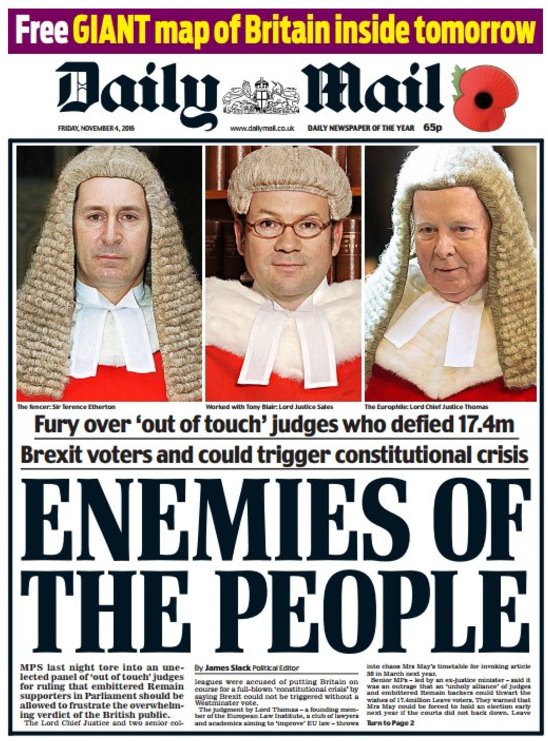
Following the release of this Judgment there has been an attack on the political and demographic origins of the three Judges, all three of whom are the product of Labour’s Lord Derry Irvine “Reforms” to the selection and promotion of the judiciary. Lord Irvine expressly said these had been engineered to “ensure that no-one with reactionary views could be appointed or promoted within the judiciary”. This expressed objective has clearly been achieved with these three judges. The


Lord Chief Justice background as an active Europhile was amply exposed in the Daily Mail article here >>> http://www.dailymail.co.uk/news/article-3903436/Enemies-people-Fury-touch-judges-defied-17-4m-Brexit-voters-trigger-constitutional-crisis.html


In the original version of the article, the Daily Mail also reported the Master of the Rolls, Sir Terence Etherton as being the first “openly gay” senior Judge and also as having married his boyfriend in “a traditional Jewish marriage ceremony”.


Lord Justice Sales was exposed as being one of Lord Irvine’s personal protégées.

So it appears that we can be reasonably confident of the personal views and political prejudices of all three judges!


From a lawyer’s point of view there was therefore, particularly with the Lord Chief Justice, good grounds for applying the approach which was adopted by the House of Lords in the Pinochet case to Lord Hoffman who had ruled based on his own political prejudices. The case can be found here>>> http://www.publications.parliament.uk/pa/ld199899/ldjudgmt/jd990115/pino01.htm


The most extraordinary aspect of this fiasco is that any reasonably competent country solicitor would have advised the Government that where a challenge was being made to legal rights to take action (in this case the Government giving notice under Article 50 of the Lisbon Treaty) the obvious thing to do is to get on with it and give the Notice.


This of course would have made it pointless continuing with the court case. The Notice would already have been accepted by the European Union and the process of leaving the EU would therefore be underway regardless of what any court had to say. In such cases the courts are very unwilling to give rulings on what are described as “moot points”. It follows that the fiasco is a product of delay and incompetence within the May Government.


Turning back to the Judgment, it is a Judgment that is more dubious on previous legal authority than it sounds as it is phrased in what has been described as “muscular” language. I would also respectfully suggest it seems to be over certain of its legal position. This is however partly a result of the incompetence of the Attorney General in agreeing that the case was “justiciable”.


As an example of arguments that show that the Judgment is more dubious than it seems, see here for an academic analysis >>> https://publiclawforeveryone.com/2016/11/04/the-high-courts-judgment-in-miller-a-brief-comment/


Here is the text of the article:-


The High Court’s judgment in Miller: A brief comment


The following short comment on the High Court’s judgment in R (Miller) v Secretary of State for Exiting the European Union [2016] EWHC 2768 (Admin) was published on the Judicial Power Project’s website and is reproduced here with permission. The piece is part of a collection of short commentaries published by the Judicial Power Project; the full collection can be accessed here. I will be publishing a more detailed piece on Miller in due course.


Some of today’s press coverage of the judgment in Miller, accusing judges of acting undemocratically, is deplorable. It is entirely right and proper that the Court should determine the legal extent of executive authority. That is an axiomatic judicial function in a democracy founded on the rule of law. But what of the content of the decision?


The judgment is striking in its muscularity. The Court considered the Government case to be so weak that it judged it untenable before even considering the claimant’s arguments in detail. The Government’s case, said the Court, was ‘flawed’ at a ‘basic level’. Reading the judgment, one might be forgiven for thinking that the Government had advanced a heterodox argument of outlandish proportions. In fact, it was simply asserting that it could use a prerogative power to begin negotiations on the international plane. None of this is to deny the subtlety of the issues to which that contention gives rise concerning the relationship between EU and domestic law, and the role played by the European Communities Act 1972 in mediating that relationship. But as John Finnis has shown, the Government’s position is far from unarguable.


Once the Divisional Court had accepted — contrary to Finnis’s view — that EU law rights are to be considered domestic statutory rights enacted by Parliament, its focus inevitably shifted to the question whether the ECA was to be read as having displaced the Government’s ability to use the prerogative to begin the Article 50 process. In concluding that the ECA had indeed produced such an effect, the Court engaged in a highly creative process of statutory interpretation that involved relying upon the ECA’s status as a ‘constitutional statute’; treating the Act’s ‘constitutional status’ as evidence of Parliament’s intention — a view that is in tension with Laws LJ’s analysis in Thoburn; invoking certain ‘background constitutional principles’ that are relevant to statutory interpretation; and asserting that those principles are particularly relevant to the construction of constitutional statutes.


My point, in this short comment, is not to assess the correctness of the court’s conclusion on this matter. Rather, it is to observe that that conclusion — and the reasoning on which it is based — is highly contestable. Perhaps, therefore, the most surprising aspect of Miller is that the confident certainty of the terms in which the judgment is framed obscures almost entirely the complexity and contestability of the questions to which it gives rise, concerning the selection, content and interaction of the constitutional principles that form the prism through which the ECA falls to be examined.”


The core of the Judgment is that the central institution within the Constitution is the Crown in Parliament. Here is a section of the Judgment well worth quoting and bearing in mind.


The principles of constitutional law: the sovereignty of Parliament and the prerogative powers of the Crown

The United Kingdom constitution
 

18. The United Kingdom does not have a constitution to be found entirely in a written document. This does not mean there is an absence of a constitution or constitutional law. On the contrary, the United Kingdom has its own form of constitutional law, as recognised in each of the jurisdictions of the four constituent nations. Some of it is written, in the form of statutes which have particular constitutional importance (as we explain at paragraphs 43-44). Some of it is reflected in fundamental rules of law recognised by both Parliament and the courts. There are established and well-recognised legal rules which govern the exercise of public power and which distribute decision-making authority between different entities in the state and define the extent of their respective powers. The United Kingdom is a constitutional democracy framed by legal rules and subject to the rule of law. The courts have a constitutional duty fundamental to the rule of law in a democratic state to enforce rules of constitutional law in the same way as the courts enforce other laws.
 

19. In these proceedings, this court is called upon to apply the constitutional law of the United Kingdom to determine whether the Crown has prerogative powers to give notice under Article 50 to trigger the process for withdrawal from the European Union. The law we were taken to was primarily the law of England and Wales, with some reference to the position in the other jurisdictions in the United Kingdom, Scotland and Northern Ireland. Although this court only has jurisdiction to apply the law of England and Wales, we note that no-one in these proceedings has suggested that such parts of constitutional law in Scotland and Northern Ireland in relation to the interaction between statute and the Crown’s prerogative powers as are relevant to determine the outcome in this case are any different from the law of England and Wales on that topic. Accordingly, for ease of reference and in view of the general constitutional importance of this case we will refer to UK constitutional law.
 

The sovereignty of the United Kingdom Parliament
 

20. It is common ground that the most fundamental rule of UK constitutional law is that the Crown in Parliament is sovereign and that legislation enacted by the Crown with the consent of both Houses of Parliament is supreme (we will use the familiar shorthand and refer simply to Parliament). Parliament can, by enactment of primary legislation, change the law of the land in any way it chooses. There is no superior form of law than primary legislation, save only where Parliament has itself made provision to allow that to happen. The ECA 1972, which confers precedence on EU law, is the sole example of this.
 

21. But even then Parliament remains sovereign and supreme, and has continuing power to remove the authority given to other law by earlier primary legislation. Put shortly, Parliament has power to repeal the ECA 1972 if it wishes.
 

22. In what is still the leading account, An Introduction to the Law of the Constitution by the constitutional jurist Professor A.V. Dicey, he explains that the principle of Parliamentary sovereignty means that Parliament has:

“the right to make or unmake any law whatever; and, further, that no person or body is recognised by the law … as having a right to override or set aside the legislation of Parliament.”

(p. 38 of the 8th edition, 1915, the last edition by Dicey himself; and see chapter 1 generally).

Amongst other things, this has the corollary that it cannot be said that a law is invalid as being opposed to the opinion of the electorate, since as a matter of law:

“The judges know nothing about any will of the people except in so far as that will is expressed by an Act of Parliament, and would never suffer the validity of a statute to be questioned on the ground of its having been passed or being kept alive in opposition to the wishes of the electors.” (ibid. pp. 57 and 72).
 

23. The principle of Parliamentary sovereignty has been recognised many times in leading cases of the highest authority. Since the principle is common ground in these proceedings it is only necessary to cite the speech of Lord Bingham of Cornhill in R (Jackson) v Attorney General[2005] UKHL 56; [2006] 1 AC 262 at para. [9]:

“The bedrock of the British constitution is … the supremacy of the Crown in Parliament …”.
 

 The Crown’s prerogative powers
 

24. The extent of the powers of the Crown under its prerogative (often called the royal prerogative) are delineated by UK constitutional law. These prerogative powers constitute the residue of legal authority left in the hands of the Crown. As Lord Reid said in Burmah Oil Co (Burma Trading) Ltd v Lord Advocate [1965] AC 75, at 101:

“The prerogative is really a relic of a past age, not lost by disuse, but only available for a case not covered by statute.”
 

25. An important aspect of the fundamental principle of Parliamentary sovereignty is that primary legislation is not subject to displacement by the Crown through the exercise of its prerogative powers. But the constitutional limits on the prerogative powers of the Crown are more extensive than this. The Crown has only those prerogative powers recognised by the common law and their exercise only produces legal effects within boundaries so recognised. Outside those boundaries the Crown has no power to alter the law of the land, whether it be common law or contained in legislation.
 

26. This subordination of the Crown (i.e. the executive government) to law is the foundation of the rule of law in the United Kingdom. It has its roots well before the war between the Crown and Parliament in the seventeenth century but was decisively confirmed in the settlement arrived at with the Glorious Revolution in 1688 and has been recognised ever since.
 

27. Sir Edward Coke reports the considered view of himself and the senior judges of the time in The Case of Proclamations (1610) 12 Co. Rep. 74, that:

“the King by his proclamation or other ways cannot change any part of the common law, or statute law, or the customs of the realm”

and that:

“the King hath no prerogative, but that which the law of the land allows him.”
 

28. The position was confirmed in the first two parts of section 1 of the Bill of Rights 1688:

“Suspending power – That the pretended power of suspending of laws or the execution of laws by regall authority without consent of Parlyament is illegall.

Late dispensing power – That the pretended power of dispensing with laws or the execution of laws by regall authoritie as it hath beene assumed and exercised of late is illegall.”
 

29. The legal position was summarised by the Privy Council in The Zamora [1916] 2 AC 77, at 90:

“The idea that the King in Council, or indeed any branch of the Executive, has power to prescribe or alter the law to be administered by Courts of law in this country is out of harmony with the principles of our Constitution. It is true that, under a number of modern statutes, various branches of the Executive have power to make rules having the force of statutes, but all such rules derive their validity from the statute which creates the power, and not from the executive body by which they are made. No one would contend that the prerogative involves any power to prescribe or alter the law administered in Courts of Common Law or Equity…”

These principles are not only well settled but are also common ground. It is therefore not necessary to explain them further.”


This approach is, to be fair, consistent with the way our Constitution Law has developed. I have previously commented that democracy is very much a bolt-on to the oligarchic principles of the British Constitution. No clearer statement of that could really be sought from any legal Judgment.

In a genuine democracy it is the “People” and the “Nation” which is sovereign, not some constitutional construct like the “Crown in Parliament”. In a genuine democracy the “Crown in Parliament” would be seen to be the delegates of the People not their masters. The People within a democracy are “citizens” not “subjects”. The United States Constitution has a greater aspiration towards being democratic than our constitution which is why there is reference to “we the People…” and court cases are brought in the name of “the People” against the accused rather than as here “the Crown” against the accused.


So what we have in this case is a strongly worded logical Judgment based on the traditional unpinning of the Constitution arising out of the English Bill of Rights and 1689 Glorious Revolution, not on the theory of democracy or any ideas of nationhood.


It looks to me from the Judgment as if the Government may also have failed to argue a distinction between directly applicable EU rights that arise through the EU system and are directly applied as a result of the European Communities Act and have agreed that those rights are the same in essence as rights arising from either Common Law or Statute. Those are the rights which previous cases have upheld as being outside the power of the Royal prerogative to change.


That being the case it may well be that the Supreme Court next month will rule to uphold this Judgment. If that is the case then be in no doubt that the giving of notice under Article 50 will require primary legislation to go through Parliament. That is an Act to be passed by both the House of Commons and the House of Lords and to be given Royal Assent and to be implemented by an Order from the Privy Council.


Such legislation to become an Act of Parliament will be subject to all sorts of quibbles and delaying tactics by the Remainers who form a huge majority of Members of Parliament and Peers. It follows that we look like we are entering a major constitutional crisis at least equivalent to that of Lloyd George’s budget in 1911, which, combined with the Irish Question, got us perilously close to civil war with the then Leader of the Conservative Party involved in smuggling arms!


There is also the tempting question to Tories of whether the Conservatives can get electoral advantage by wrong-footing Labour into outright opposition to such a bill and then being able to get a two thirds majority in the House of Commons for a snap election under the Fixed Terms Parliament Act!


As a postscript would the Conservatives campaigning for a mandate to trigger the Article 50 notice be temptingly likely to achieve Theresa May’s aim of destroying UKIP?


It will also be interesting to see if Labour can actually survive as a Party outside of the metropolitan areas on a ticket of opposing Brexit when a vast majority of their voters in much of the rest of England voted to Leave in June’s EU Referendum!