Total Visits

Tuesday, 12 May 2015

General Election


While this election has been not only very long and was fixed in the calendar for several years, it has been interesting to see that there has been much more polling evidence than usual, particularly with Lord Ashcroft’s polls.

It has also been interesting to see that despite the £100 million or more that the Establishment parties and UKIP have spent between them on billboards, leafleting and social media based canvassing and telephone canvassing it seemed to have made very little difference between the two main parties until the last moment; more of that later!

These were interesting elections in the second tier of parties about the SNP, the Liberal Democrats and UKIP. Now we see their results!

So far as UKIP is concerned the result was a devastating disappointment. Not only has UKIP proved a disappointment to English nationalists, as per one of my earlier blog articles, but won’t even have satisfied their British nationalist supporters.

The SNP’s results in Scotland have brought the end of the Union very much back onto the agenda. One of the burning issues of the next five years will therefore I think be the need for a voice for English nationalism.

In the last 18 months it has been UKIPs time in the sun. Their failure to deliver leaves, I think, the way wide open for the only English nationalist party to come forward.

The English Democrats are now an experienced party of campaigners dedicated to England and our English nation and will not be blown off course by the winds and noise of political storms and while we may not agree with the Scottish National Party on the vast majority of their policies, the one thing that we do agree with them on is the need for an effective voice for our Nation.
 

In an imaginary play we might have:-
 

Stage directions: Enter - triumphant SNP contingent.

Exit - dejected Liberal Democrats and UKIP contingents.

Enter - determined band of English Democrats with Cross of St George flat flying to cries of horror and alarm from the British Media Establishment chorus!

Thursday, 7 May 2015

MY SPEECH FOR AFTER THE COUNT TONIGHT


MY SPEECH FOR AFTER THE COUNT TONIGHT


Ladies & Gentlemen

I would also like to thank the Returning Officer and all his/her helpers who have worked on this election and also those voters who have voted for me and for the English Democrats.

I have enjoyed standing in this election and playing my part in flying the flag for England and for English nationalism.

I am going to be very interested in seeing what now happens. If, as the polls suggested, Labour is able to form a minority government only with the assistance of the Scottish National Party, Plaid Cymru and possibly Sinn Fein and other Irish nationalists, then I fully expect many voters who voted for other parties to wish that they had voted for the English Democrats to be a voice for England. 


That voice will be sorely missed because for the next 5 years we may have a government which is more anti-English than any government that England has had since the Norman Conquest.

As I speak poor England is now being delivered into the hands of our Nation’s enemies.

I hope that the experience of the next 5 years will ensure that never again will anyone who cares for England vote for any party which hasn’t got “Putting England First” at its very heart!

UKIP FAILS THE ENGLISH TEST

UKIP FAILS THE ENGLISH TEST

When Nigel Farage got re-elected as Leader of UKIP there was a distinct move in UKIP, for a time, to portray itself as being, at least to some extent, an English nationalist party. 


Given the various dirty tricks and other activities that were going on with UKIP at the time against us, it seemed obvious to the English Democrats’ National Council that these moves were just designed to undermine the English Democrats, rather than a genuine change of heart.

Over the years since we have had various people say to us that UKIP is an English nationalist party and try to persuade us that we should therefore join forces.

It is obvious from looking at Twitter, Facebook and the internet generally that there are a great many others out there who had also thought of UKIP as being an English nationalist party.

During the course of this General Election the scales should have fallen from all those peoples’ eyes as UKIP has shown itself to be very clearly not an English nationalist party. Nigel Farage has even expressly denied being an English nationalist (and, indeed, even a British nationalist, no doubt to the somewhat surprise of his British nationalist members!).

Not only has Nigel Farage’s new UKIP (British) manifesto very limited mention of England or the English, but their slogan in this election was “Believe in Britain”. Also despite clear commitments in the past to produce an English manifesto it has not been produced. In stark contrast they did launch a Scottish-only manifesto. Last, but not least, we have had a series of very clear remarks from others in the leadership of UKIP that they are British Unionists and not about English nationalism at all.

Probably the clearest example is the comments of David Coburn MEP, who before he became elected as an MEP had for many years been UKIP’s principal organiser in London. Click here for a link to YouTube where we have recorded his very clear answer as to where UKIP’s national loyalties lie >>> https://youtu.be/QSuT0JjgSjY

In fact, of course, nobody should have been surprised, the answer was always in UKip’s name! I wonder if people would have understood that more easily if they had called themselves BRITKIP?

What do you think?

Friday, 1 May 2015

Professor Robert Tombs on the Uniqueness of England


Professor Robert Tombs on the Uniqueness of England


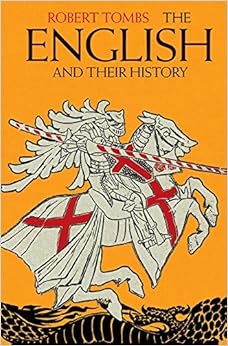
For my birthday I was given a book:- 'The English and their History' by Professor Robert Tombs. 


This is a book that I would recommend to anyone interested in the history of England and the English people. Here is an extract which particularly appealed to me. See what you think:-

“What is unique about England lies in the realm of politics: the early development, in response to Viking invasions, of a powerful kingdom occupying a defined territory, with a system of government in which a large part of the population participated, whether they liked it or not – through courts and juries, through tithings, through labour, taxation and military service, through the use of royal coins, and, for the powerful, through royal councils and parliaments. 


Some historians have suggested that this made England the prototype of the nation-state. Similar institutions to those of England had existed at times in other parts of Europe, particularly under the empire of Charlemagne, but they were swept away. In England they survived. Being a powerful and yet vulnerable kingdom, able to raise taxes and impose law and order, and yet subject to disputed royal succession and foreign invasion, it’s Kings needed the support of their people, and the people high and low needed to control the actions of their Kings. Anglo-Saxon institutions, some of very ancient origin, were preserved and developed by the post-Conquest monarchy, which extended royal justice and created a common law. 

The country of Bede’s gens Anglorum was never divided up into autonomous and warring feudal territories. Instead, the “community of the realm” imposed the rule of law on its powers and on its post-Conquest monarchs to a degree unique in Europe.

The common law in Magna Carta was seen not as revolutionary innovations, but as restatements of ancient principals. The distinctiveness of the common law became a source of pride …

This (took) on weighty ideological significance: the law was claimed to be above and beyond royal absolutism and hence the safeguard of liberty. This significance it has subsequently retained, at least subliminally. 


Moreover by an unpredictable historical twist, “the insular and arcane learning of the small band of lawyers who argued cases in the corner of Westminster Hall became the law by which the third of the people of the earth were governed and protected, the second (after Roman Law) of the two great systems of jurisprudence known to the world”.

Continuity is crucial in this story. Many of the jumbled ingredients of nationhood, beliefs, myths, institutions, customs, loyalties – that were already present in the 9th Century were revived or reinvented in the 12th. 


Thereafter they gained in potency because they persisted, deriving legitimacy from their ever growing antiquity, enhanced by linking them with the real or mythical pasts of St Edward the Confessor and King Arthur. England’s laws and institutions came to seem untouchable and immutable, as if in the nature of things, dating from time immemorial. They could then be seen in Edmund Burke’s famous phrase of 1791, as creating “a partnership between those who are living, those who are dead, and those who are to be born”. In such ways nations and identities are “constructed”: that is made by people, and not determined by geography, genes or blood.”


Tuesday, 28 April 2015

PM’s nationalist stance welcomed in Western Daily Press

PM’s nationalist stance welcomed

In the Western Daily Press (Bristol, England) - April 29, 2015 on Page:18 appeared this cheeky item:-


The English Democrats welcome David Cameron’s apparent concession to the cause of fairness for England even if he continues in his and many other Conservatives’ recent tradition of disparaging English nationalists and English nationalism.

Ed Miliband however in his response seems to be confirming his and Labour’s position as the anti-English party.

I welcome David Cameron doing anything which will further the cause of English nationalism. In the words of St Luke, “I say unto you, that likewise joy shall be in Heaven over one sinner that repenteth, more than over ninety and nine just persons, which need no repentance”.

Robin Tilbrook

Chairman, the English Democrats

Wednesday, 15 April 2015

Our General Election Press Launch – Even Sky News came too!


Our General Election Press Launch – Even Sky News came too!

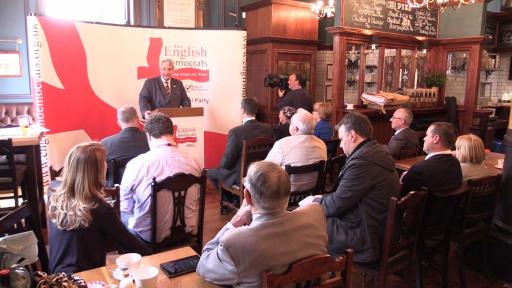
As I mentioned in my previous Blog item, over the years we have tried hard to get our press launch covered. 

This has always previously been a struggle but this year we did get some interest, both from ITV and, in particular, from Sky, who actually sent a reporter.

We were briefly on the Sky News and also a more detailed report was done for Sky’s website. Here is a link to the article, click here >>> Coalition With Nationalists 'Would Be Treason'

The text is slightly off what I said because I wasn’t accusing Scottish and Welsh Nationalists of being traitors to their countries, but my point was focussed more on Ed Miliband and the Labour leadership.

But leaving that aside, I think the Sky reporter has done a good job.

What do you think?


Monday, 13 April 2015

Thoughts on our Campaign Press Launch, April 2015


Thoughts on our Campaign Press Launch, April 2015


It has been one of the recurring bug bears of trying to get our political party up and running and publicised, that whenever we are entitled to a little bit of coverage, the coverage that we have actually been given has generally been the niggardly minimum that the BBC can get away with.


As part of standing in the General Election or any major election the rules say that we are entitled to a press launch to be covered by being mentioned on the BBC News and on the BBC website and perhaps also an interview on the BBC’s Politics Show.


Over the years the BBC have chosen to minimise the effectiveness of that coverage by various means. On one occasion they showed supporters milling about rather than the display we had organised or anybody making a speech. On other occasions they have panned around to show that the rest of the room is quite empty. Of course they knew that it would be as this is a completely artificial arrangement, designed only to get some publicity rather than proper meeting! On some occasions they have shown me making a speech but done a voice over of whatever not so encouraging thing they wanted to say about us!


So on this occasion I thought there wasn’t much point in making a great effort to prepare a detailed speech. So, of course, this is the first occasion where they have actually broadcast my speech, or, at any rate, part of it, on the BBC Parliament Channel! Here is a link to view the outcome of that >>> http://www.bbc.co.uk/iplayer/episode/b05qqfjp/election-2015-english-democrats-campaign-launch.


Naturally had I known that they were going to broadcast 10 minutes of speech, I would have made sure that it was much more punchy and slick. I would also have focussed more on covering the key points as to why England is so badly disadvantaged by the current constitutional arrangements.


On the bright side, perhaps what they have done in this case is part of the growing recognition of the English Democrats. In future I may need to expect my speech to be covered! If so, I can promise far less um’s and r’s!


What do you think of the video?


Also here is what was put up on the BBC website >>> Election 2015: English Democrats launch campaign with attack on 'traitors' - BBC News


What do you think?