Total Visits
Tuesday, 5 February 2013
Peter Davies resigns from another Party!
It is with a little regret that the English Democrats and our Elected Mayor of Doncaster, Peter Davies, are parting company.
It’s always been something of a roller coaster ride with Peter and his regular gaffes (including his notorious suggestion that the Taliban could teach English people a thing or two about family values), but as Peter has got older he has become ever more inclined to speak without thinking first, let alone doing any research as to whether his facts are correct.
In the time since he was elected, Peter has regularly threatened to resign, usually on petty internal Party matters. It therefore comes as little surprise that he has eventually found something to actually resign over, even if it is something he hasn’t properly researched or thought about or made any serious attempt to understand or to engage with what we as a Party are trying to do.
Peter’s election was a pleasant but not entirely unexpected pleasure for us, the English Democrats, as we are the sensible and moderate English nationalist Party and our tide is rising. Although Peter’s previous involvement with politics was very chequered, having belonged to many political parties and his forays into elections were always previously attended with failure, nevertheless, having started to campaign for the English Democrats, he had found that he was getting very much more support electorally than anything he had achieved before.
Peter often said to me that he liked the title of being “Maverick Mayor” and he has certainly lived up to that title, even if his commitment to English Nationalism has always been somewhat tepid. To take one example among many, he flatly refused to help promote St George’s Day in Doncaster because it would conflict with his attendance at the Scottish horseracing “Festival” in Perth.
At this stage I am not aware if Peter has given up on the possibility of being re-elected - given his previous electoral track record that would be understandable. As Peter has made very little effort to help us build the English Democrats his absence from our ranks is unlikely to be much missed. The English Democrats will be standing a sensible moderate English Nationalist candidate in the next Doncaster Mayoral elections and we will be announcing our candidate in the next fortnight.
Peter’s conduct, whilst disappointing for us, is also a betrayal of the 25,344 English Democrats’ voters in Doncaster that elected him in the first place, the 31,287 Yorkshire voters who voted for us in the EU elections, and the 32,386 votes from Doncaster that the English Democrats have received since.
Whilst it is true that a few former members of the British National Party have joined the English Democrats this is a fact that is also true of other parties, including the Labour Party, who now have a former BNP councillor and parliamentary candidate as a councillor in Lancashire.
Peter has never been willing to take his politics seriously, always putting his passion for horse racing first. It is one thing being maverick but quite another to both attack people he has never met nor troubled to find out anything about and to turn on the Party which gave him his only electoral success.
All parties have similar problems to our ones with Peter but I won’t hide that it is a disappointment that Peter has proved as disloyal to us as to so many of the other parties which he has previously belonged to.
Robin Tilbrook,
Chairman,
The English Democrats
Conservative Party melting like summer snow? (In Scotland!)
Here is a thoughtful and indeed a thought provoking article on the future
of the Conservative Party in Scotland.
When Ruth Davidson won their leadership contest I blogged this article
>>> http://robintilbrook.blogspot.co.uk/2011/11/scots-tories-vote-for-pc-timidity.html
I am hopeful that as English Nationalism really takes hold in England we
will read similar pieces about the Conservative Party’s future prospects in
England. They will deserve their fate. We English Nationalists should never
forget these comments by Conservative William Hague:- “English Nationalism is
the most dangerous of all forms of nationalism”.
Or
this by Dave
Donald Cameron:- “I’ll take on the sour Little Englanders, I’ll fight them
all the way”.
Here is the article:-
Too little too late for
Tories?
By ANDY MACIVER
Published by The Scotsman on Thursday 31 January 2013
The Scottish Conservative Party is a peculiar outfit. I had
come to realise this long before I left its employment, its membership and its
dwindling ranks of voters in 2007. I had just finished writing a manifesto that
was heavy on style and rake-thin on substance, and planning and executing a
media strategy for Annabel Goldie who, as nice a lady as she is, had neither the
inclination nor the instinct to know that her party was doing a disservice to
itself, to the centre-right and to politics in Scotland. Massive and radical
change seeming far away, I got out.
Four years later, Tory MSP Murdo Fraser asked me to run strategy and communications for a leadership campaign that could – and should – have changed the face of Scottish politics. For me, this was never about adding a few Tory MSPs to the three black cabs-worth currently at Holyrood: it was about being at the forefront of a long-needed reorganisation of Scottish politics.
The biggest weakness of Scottish politics is the absence of a centre-right, liberal force – a unique characteristic among developed countries. The omnipresence of the constitutional question has led to the cementing of centre-left thought as mainstream, with Labour and the SNP split not by ideology, but by identity.
Scotland needed a fresh start. Like most countries, Scotland has an enormous cohort of people who think centre-right – probably more than a million voters. Unlike other countries, though, they consider themselves to have no option but to vote centre-left.
Murdo wanted to give them one. We advocated a new, liberal, centre-right, Scottish party. Not a new version of the Conservatives; not a replacement for the Conservatives; not a club for former Conservative members, but a new party, with new people, advocating new policies. It would be a Scottish party taking the London whip at its own discretion; not a London party cracking the whip in Scotland without knowledge or consideration. It was the right time for a new party. With the independence referendum on the way, a decisive No vote (something of the order of 75:25) has the potential to cause a split in the SNP and pave the way for a range of new political parties, based broadly around the competing ideologies of liberalism and socialism.
It would be a logical outcome in a country where a party badge can reveal little about an MSP’s ideological compass. We have SNP MSPs, such as Fergus Ewing, who share much more in common with Murdo Fraser than they do with those on the left-wing of their own party, such as Sandra White.
We have similar figures in Labour and the Liberal Democrats, such as Ken Macintosh and Tavish Scott, who would also naturally gravitate to the same liberal platform as Fraser and Ewing, rather than sharing one with the likes of Elaine Smith, on Labour’s hard left. There is little sense to the composition of our current parties.
Draft 23 of Murdo’s launch speech – the one he delivered – outlined with brutal honesty and clear forethought three key pillars for change. Like three legs of a tripod, we sought to make it clear that you could not cherry pick one or two without risking collapse.
First was the acceptance of the problem. Not poor policies, or poor people, or a lack of hard work, but a dud party, which was losing almost 40,000 votes at every election because people couldn’t bring themselves to vote for it, despite liking many of its policies. The Tory vote was literally dying.
Second was an affirmation of Murdo’s long-standing commitment to massive constitutional change. A new Union based on fiscal autonomy for a more responsible, accountable Scottish Parliament; the Scotland Act 2012 with rocket-boosters (which, incidentally, would do no harm to the Tory vote north of the M25, which sees Scotland as a subsidy junkie).
And third, a new party, acknowledging the fact that the Scottish Conservative and Unionist Party was no longer a vehicle capable of delivering any message to the Scottish people. It was too toxic, too far-gone, with unpopularity ingrained into generations of Scots.
Murdo lost. Ruth Davidson –picked and backed by Downing Street, David Mundell, Lord Forsyth and Scottish Central Office – won on a simple ticket. First, there were no fundamental problems; we just need to shout louder. Second, the Scottish Parliament needed no more powers – in fact, you’re lucky to have what you have. This was a line in the sand. And third, we most certainly did not need a new party – the Scottish Tories once got more than 50 per cent of the vote, don’t you know? To scrap it would be an act of treachery akin to Bonnie Prince Charlie turning back at Derby, so went the line from the attack-dogs.
Then last week, 18 months on, all changed. Ruth made a speech acknowledging that the party’s problems are more fundamental than bad marketing, and accepting that Scotland doesn’t trust the Tories.
A U-turn? Of course – although detail is too light to know the scale of it, but it is an extremely welcome one nonetheless. Ruth’s speech presented the party with some home truths from which it cannot escape.
However, the Davidson speech was not without its deficiencies. First, it conceded only one of Murdo’s three pillars – the fact that the party, not the policy, is the problem. It was a speech that posed several questions but answered none; a speech that left its audience with the view that Ruth understood the problems but could not put her finger on a solution.
It hinted towards conceding Murdo’s second pillar – fiscal autonomy – at a future speech in the mini-series, but we know no detail of to what extent, beyond the clunky comments made by Mundell in the days before the speech.
Then there is the third pillar. The large elephant in the small room remains the impotence of the Scottish Tory party. During the leadership election, Murdo make clear that a new captain was not enough; we needed a new ship. It is no less true now than it was then.
The cold, hard reality is that the million-or-so Scottish centre-right thinkers will never be centre-right voters as long as the name on the ballot paper says Scottish Conservative and Unionist. It is socially unacceptable to vote this way. The theory that this can change through force of argument or personality has been tested to destruction. It cannot be done.
Ruth is capable of much. At no point have I doubted her potential. She is bright and articulate, and in John McLellan (the former editor of The Scotsman) she has hired a good, clever right-hand-man with more than enough experience in this game to know just how deep the party’s problems run.
However, her party is a ball and chain, hampering her progress. She cannot succeed without embracing the logical solution to the problems that she herself identified last week.
Will she? The signs are not good. Because the great irony of Ruth’s speech last week, and the two further ones she is due to deliver, is that they are the brainchild not of a new self-confident Scottish party, but of the party in London.
London had to persuade Edinburgh to make this speech, having finally come to the conclusion that its Scottish arm is a lifeless drag on the rest of the party. The more things change, the more they stay the same.
• Andy Maciver is a director at Message Matters, a strategic communications consultancy in Edinburgh, and ran strategy and communications for Murdo Fraser’s leadership campaign
http://www.scotsman.com/news/andy-maciver-too-little-too-late-for-tories-1-2767611
Monday, 4 February 2013
Hate filled, anti English Nick Lowles refuses to engage in open debate!
Here is a guest post:- Hate filled and anti-English Nick Lowles refuses to engage in open debate about the important role that English civic nationalism has in creating a cohesive society.
The anti-English
Nick Lowles is at his lying and smearing best again. It is now becoming
abundantly clear that Nick Lowles who once was an advocate of “Hope not Hate”
has become a man filled with ‘hate not hope’. Self righteousness and pride come
before a fall. Twisting the truth eventually leads to slander and will show how
anti-English Nick Lowles really has become.
Let me
explain.
When Nick Lowles
mentions that several Ex-BNP members who have joined the English
Democrats he conveniently forgets to tell you the following about Labour
Party members:-
· That Jack Straw
used to belong to the Communist Party (exactly how many people have Communists
killed Nick?
· That Ed Balls
wore a Nazi outfit when at University (see http://www.thejc.com/news/uk-news/84673/ed-balls%E2%80%99s-not-embarrassed-nazi-pic)
· That various
ex-BNP or Far Right members have joined the Labour Party and that at least two
are now Labour Councillors.
· That Ken
Livingstone regularly made extremist comments.
· Labour’s Lord
Ahmed is alleged to have placed a £10 millilion bounty on the head of Obama
(click here>>> http://www.dailymail.co.uk/news/article-2130256/Lord-Ahmed-Rotherham-offers-10m-bounty-detain-Obama.html#axzz2JsGBUqjC ).
· Look at Salma
Yagoob controversial comments >>> http://blogs.telegraph.co.uk/news/danhodges/100180603/salma-yaqoob-once-described-the-77-murders-as-reprisal-attacks-she-doesnt-belong-in-the-labour-party/
Also on the Left, look
at the recent revelations about the Socialist Workers Party’s cover up about a
colleague’s rape >>>
http://socialistunity.com/how-the-revolutionary-left-has-systematicaly-failed-to-prevent-sexual-abuse/
Do we hear any
criticism from “Nick" about any of these?
All I ask you to
do is to ponder the hypocrisy of Nick Lowles' stance. Labour’s dirty trick
department comes to mind!
Nick Lowles also
forgets to tell you about his past as well. Please look at this link
>>> http://en.metapedia.org/wiki/Nick_Lowles.
Be careful when listening to his words!
All the English
Democrats want to do is to unite England and ensure that our people have a
democratic voice. We are trying to unite a country that is facing huge cutbacks.
To unite people you need to be prepared to listen to their views, you need to
apply the Christian principle of forgiveness and you need to allow people to
change their minds.
Nick can only say
that the ‘English Democrats are firmly in his sight’ because he does not have
anything that makes us extremists, all we are doing is what any respectable and
democratic Political party should do and that is meet people so we can explain
our policies. Sorry Nick, I know you don't want to hear this but we demand that
any new members follow our moderate English nationalist approach.
The reason Robin
Tilbrook has repeatedly challenged Nick to an open debate is to show that we
speak the truth, that moderate English nationalism is important in bringing our
communities together. Instead of engaging in open debate Nick Lowles hides
behind his keyboard and spills out hate and untruths.
The English
Democrat have nothing to hide, we speak the truth, we simply believe that
England is being treated unfairly. Initially Nick Lowles agreed to a debate but
then no doubt he thought that he wouldn’t win it so now he refuses to
debate.
Now Nick Lowles
condemns the English Democrats for trying to stop Nick Griffin from a winning
seat. Strange what anti Englishness makes you say Nick? You should be praising
us if there was any consistency to your line of attack!
He goes further
and attempts (behind his keyboard) to accuse us of filling the vacuum left by
the electoral collapse of the BNP but the truth is he is more concerned that we
are taking votes from traditional Labour areas.
Please remember
that one million people voted for the BNP and probably most of those were once
Labour supporters or voters.
All you need to
do is to look at the success of the English Democrats’ Mayor in the once Labour
heartlands of Doncaster and also our second place in the South Yorkshire Police
Commissioner elections in November. That happened without us being able to, even
remotely, match the campaign spending of Labour!
What Nick Lowles
fears is what the English Democrats will be capable of when we get through to
the over 70% of people in South Yorkshire who consider themselves to be
English!
Friday, 25 January 2013
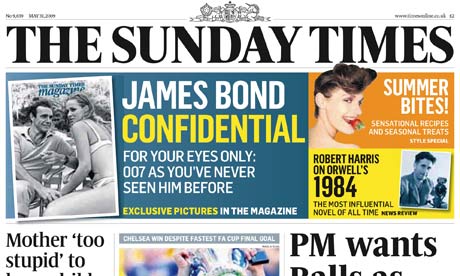
SUNDAY TIMES RETRACTS EXTREMIST SLUR AGAINST ENGLISH DEMOCRATS
On Sunday, 20th January 2013 the Sunday Times published in its corrections and clarifications column on page 24 as follows:-
"A story on the election of police and crime commissioners (Party plodders turn police vote into a flop, November 11, 2012) wrongly referred to the English Democrats as an 'extremist' party. The English Democrats are a nationalist party campaigning, among other things, for an English parliament.”
And on its website it also published a correction as follows:-
“An earlier version of this article wrongly referred to the English Democrats as an 'extremist' party. It is a nationalist party."
These corrections followed on from a complaint to the Sunday Times and thereafter to the Press Complaints Commission. The correspondence is set out below. The results do show that proper, reasoned complaining and challenging of media inaccuracy can produce worthwhile results.
Here is the correspondence:-
From: RobinTilbrook@aol.com
To: john.witherow@sunday-times.co.uk, james.harding@thetimes.co.uk, home.news@thetimes.co.uk
BCC: johnhayterengdem@aol.com
Sent: 11/11/2012 19:18:25 GMT Standard Time
Subj: Your offences - Section 61 of the Police and Crime Commissioner Elections Order
Dear Sir
We act for Mr Steven Uncles, Mr David Allen, Mr Stephen Goldspink, Mr Paul Rimmer and Mr Robin Tilbrook who are the English Democrats' candidates for the Police Commissioner elections in Kent, South Yorkshire, Cambridgeshire, Merseyside and Essex respectively.
As you may be aware, pursuant to Section 61 of the Police and Crime Commissioner Elections Order 2012, you are “guilty of an illegal practice” if during this election and for the purpose of affecting the election of any candidate as Police and Crime Commissioner you make or publish any false statement of fact in relation to the candidates personal character or conduct.
Contrary to Section 61 this Sunday the Sunday Times has on page 11 published an Article by James Gillespie and Georgia Graham headed " Party plodders turn police vote into a flop" in which you have published the following statement about the above candidates:- "The figures show that 134 of the candidates are representatives of the political parties - among them five from the extremist right-wing English Democrats".It is a false statement of fact that the English Democrats are "extremist right-wing".
You have also gratuitously made disobliging and disingenuous partisan remarks about their candidacies.
In the circumstances we write to request a full right of reply for our clients to be published in an issue of your daily paper before Thursday's election.
Please confirm your agreement to the above within the next 48 hours failing which we shall advise our clients on whether to proceed by way of criminal prosecutions or to seek a High Court Injunction against you.
Yours faithfully
Tilbrook’s
In a message dated 13/11/2012 15:02:56 GMT Standard Time, pia.sarma@newsint.co.uk writes:
Dear Mr Tilbrook,
Your email to the Editor of The Sunday Times which published the article you refer to, has been passed to me for response.
The Sunday Times and The Times are entirely separate publications with separate editors. A request for a right of reply arising from one publication cannot be considered by a separate publication. For that reason your request for a right of reply in the daily paper is not something which can be met in any event.
I do intend to respond to you in full but as this has only just been brought to my attention, I will do so by the end of tomorrow.
Yours sincerely,
Pia Sarma.
---------------------------------------
Editorial Legal Director
Legal Department- 4th floor
Times Newspapers Limited
From: RobinTilbrook@aol.com
To: pia.sarma@newsint.co.uk
Sent: 14/11/2012 01:02:40 GMT Standard Time
Subj: Re: Your offences - Section 61 of the Police and Crime Commissioner Elections...
Dear Ms Sarma
Thank you but please note they are the same ownership and the same email address
Robin Tilbrook
From: donna.boultwood@newsint.co.uk
To: robintilbrook@aol.com
CC: pia.sarma@newsint.co.uk
Sent: 15/11/2012 16:45:50 GMT Standard Time
Subj: Times Newspapers Limited
Dear Mr Tilbrook
Please see the attached letter sent on behalf of Pia Sarma.
Yours sincerely, Donna Boultwood
P.A. TNL Legal Department
Times Newspapers Limited
Letter from Times Newspapers Limited dated 15th November 2012
Dear Tilbrook
Re: “Party plodders turn police vote into a flop”, The Sunday Times, November 11
Thank you for your letter to the Editors of The Sunday Times and The Times, concerning the above article.
You appear to ask for a right to reply on the basis that publication of the Article was an offence under section 61 of the Police and Crime Commissioner Elections Order 2012.
The statutory instrument creates an offence if anyone makes or publishes any false statement of fact in relation to an election candidate’s personal character or conduct before or during an election and which was for the purpose of affecting the election of that candidate. If the maker of the statement can show that he has reasonable grounds for believing the statement to be true, there is no offence.
I do not agree that the offence has been made out. Firstly, describing the English Democrats as “extremist right-wing” was not necessarily a statement of fact. A statement about the political leanings of candidates is often a matter of opinion. Even if the statement were found to be fact, it is not one which related to any of the candidates personal character or conduct, as is required for an offence to be made out, but rather to political or public role in the party. A Court would also be required to take into account freedom of expression and Article 10 of the European Court of Human Rights in examining the value judgment of the statement. Where any statement does not substantially relate to personal conduct, it may be inconsistent with Article 10 for the Court to find that s.61 would apply, as a recent case held.
It also would not be shown that the statement was made for the purpose of affecting the election of any candidates. Indeed, had that been the intention, each of the candidates would have been named to draw the attention of any potential voter. The article points out that the expected turn-out was anticipated to be disappointingly low, which highlights the need for any article whose purpose was to affect election to be quite specific about its intention in order to capture a potential voter. Finally, the defence of reasonable belief in the truth of the statement may be made out. In summary, the elements of the offence were not met.
As I stated in my email to you, The Times does not carry letters or comment by way of right of reply in relation to articles published in The Sunday Times. However, if you wish to submit a letter to be considered for publication in The Sunday Times, please send it to letters@sunday-times.co.uk, copied to me.
Yours sincerely
Pia Sarma
Editorial Legal Director
Letter 6th December 2012
Press Complaints Commission
Halton House
20/23 Holborn
London
EC1N 2JD
Dear Sir
Re: Sunday Times Article 11th November 2012 by James Gillespie and Georgai Graham: “Party plodders turn police vote into a flop”
This article wrongly asserts that the English Democrats are “Extremist Right-wing”. This comment is inaccurate and untrue. The significance of this unjustified attack taking place in the midst of elections for Police Commissioners makes this matter one of importance.
Immediately this article came to my attention, on the 11th November, I requested the right of reply to this spurious allegation. The response is inadequate and it is obvious that the offending comment is put as a statement of fact not opinion (within the usual meaning given both by the law of defamation and of common sense).
"Extremist right-wing" connotes fascism, racism, Nazism, white supremacy etc., and infers that the English Democrats candidates share those views. It thus clearly relates to our candidates' personal character or conduct. In the context of the article, its timing, and the absence of defamatory comments about any other candidates an inference can be drawn of the improper purpose of affecting the election of our candidates.
This may actually have mattered given that we were not far off getting our candidate elected in South Yorkshire.
I respectfully suggest that the Times would be hard pressed to support any defence of reasonable belief in the truth of the statement. There is no suggestion anywhere that we are a racist party, nor indeed have they made any effort to find out what we do stand for.
No effort was made to speak to anyone from the English Democrats about this allegation either prior to making it or indeed at all.
Not only do James Gillespie’s and Georgia Graham’s professional standards appear to be very sloppy, but also, I would respectfully submit, they breach the Press Complaints Commissions Editor’s Code by failing to maintain the “highest professional standards”. The comments are frankly inaccurate and misleading and no correction has been published.
Rather than accurately reporting the Sunday Times seems to have stooped to smear and innuendo against the English Democrats.
It may also be that the smear derives from an anti-English discriminatory attitude within the Sunday Times and also of these two journalists both of whom bear Scottish surnames.
In the circumstances I wish formally, and on behalf of myself and the other candidates so smeared and the English Democrats, to complain against the Sunday Times.
Yours faithfully
R C W Tilbrook
Chairman
In a message dated 12/12/2012 15:56:57 GMT Standard Time, simon.yip@pcc.org.uk writes:
Dear Mr Tilbrook
Thank you for your email.
Before we can assess your complaint fully, it would be helpful if you could indicate which Clause or Clauses of the Code of Practice you believe have been breached.
We would be very grateful to receive this information within the next ten days.
A copy of the Code of Practice which all newspapers and magazines who subscribe adhere to, can be accessed using this web link: http://www.pcc.org.uk/cop/practice.html
Do not hesitate to contact us if you need further advice. When you write to us, please quote our reference number on this email.
Yours sincerely
Sent on behalf of Simon Yip
Complaints Coordinator
Press Complaints Commission
From: RobinTilbrook@aol.com
To: simon.yip@pcc.org.uk
Sent: 26/12/2012 15:59:05 GMT Standard Time
Subj: Re: Press Complaints Commission - Our reference 125459
Dear Mr Yip,
Thank you for your email. I am sorry not to have responded sooner.
I had used the key phrases from clauses 1,2 and 12 deliberately as these the ones called into play here.
I attach the text of my complaint again for ease of reference.
Yours sincerely
Robin Tilbrook,
In a message dated 03/01/2013 10:09:02 GMT Standard Time, elizabeth.cobbe@pcc.org.uk writes:
Our reference: 125459
Dear Mr Tilbrook
Thank you for your recent correspondence.
I will be dealing with your complaint against The Sunday Times before it goes to the Commission for a decision under the terms of the Editors’ Code, and I will keep you informed of the progress of our investigation into this matter.
A copy of your correspondence has been sent to the publication and I will write to you again once I have received its response.
In the meantime, do not hesitate to contact me if you have any concerns or questions.
Yours sincerely
Elizabeth Cobbe
Complaints Officer
Press Complaints Commission
From: RobinTilbrook@aol.com
To: elizabeth.cobbe@pcc.org.uk
Sent: 03/01/2013 10:10:21 GMT Standard Time
Subj: Re: PCC REF 125459
Thank you
Robin Tilbrook
In a message dated 08/01/2013 11:23:00 GMT Standard Time, elizabeth.cobbe@pcc.org.uk writes:
Dear Mr Tilbrook,
I write further to my email of 3 January.
I have now received a response from The Sunday Times, which I have forwarded below.
As you will see, the newspaper has offered to publish the following correction in its Corrections and Clarifications column:
"A story on the election of police and crime commissioners (Party plodders turn police vote into a flop, November 11, 2012) wrongly referred to the English Democrats as an 'extremist' party. It is a nationalist party."
I would be grateful for your thoughts on this proposal, and in particular whether you would be satisfied that this course of action would resolve the complaint to your satisfaction. As you may be aware, an additional benefit of resolving your complaint is that a summary of it – with a wording agreed by you – will be published prominently on the Commission’s website. This will act, importantly, as a public record of your concerns and the remedial action subsequently taken.
I look forward to hearing from you in due course, preferably in the next seven days.
With kind regards
Elizabeth Cobbe
From: Tyrer, Bob
Sent: 08 January 2013 10:21
To: Elizabeth Cobbe
Subject: Re: New complaint - 125692 Tilbrook
Dear Elizabeth,
Thank you for forwarding this complaint to me.
I have researched the English Democrats' website and activities, and I agree that there is no evidence of political extremism in the normally accepted use of the word - implying violence. I would therefore be happy to resolve this complaint with an entry on these lines in our Corrections and Clarifications column: "A story on the election of police and crime commissioners (Party plodders turn police vote into a flop, November 11, 2012) wrongly referred to the English Democrats as an 'extremist' party. It is a nationalist party."
With best wishes,
Bob
Bob Tyrer
Executive Editor
From: RobinTilbrook@aol.com
To: elizabeth.cobbe@pcc.org.uk
Sent: 08/01/2013 12:54:50 GMT Standard Time
Subj: Re: PCC complaint 125692 Tilbrook
Dear Miss Cobbe
Thank you for your email. The suggested wording goes some way towards satisfying me. I suggest that the second short sentence should read:- "In fact the English Democrats are the main English Nationalist Party and are campaigning for an English Parliament"
Yours sincerely
Robin Tilbrook
Chairman,
The English Democrats
In a message dated 08/01/2013 15:37:11 GMT Standard Time, elizabeth.cobbe@pcc.org.uk writes:
Dear Mr Tilbrook,
Thank you for your earlier email.
As you will see from the below response from the newspaper, it has made a final offer to publish the following wording:
"A story on the election of police and crime commissioners (Party plodders turn police vote into a flop, November 11, 2012) wrongly referred to the English Democrats as an 'extremist' party. The English Democrats are a nationalist party campaigning, among other things, for an English parliament."
It has organised for the removal of the word “extremist” from the article which appears on the website of the newspaper and to publish the following footnote to the article:
“An earlier version of this article wrongly referred to the English Democrats as an 'extremist' party. It is a nationalist party."
I look forward to hearing from you as to whether you would like to resolve the complaint on the basis of these steps.
With kind regards
Elizabeth Cobbe
From: Tyrer, Bob
Sent: 08 January 2013 15:24
To: Elizabeth Cobbe
Subject: Re: PCC complaint 125692 Tilbrook
Dear Elizabeth,
Thanks for your reply.
I would be willing to compromise with this wording: "A story on the election of police and crime commissioners (Party plodders turn police vote into a flop, November 11, 2012) wrongly referred to the English Democrats as an 'extremist' party. The English Democrats are a nationalist party campaigning, among other things, for an English parliament."
That is my final offer on the wording. I also agree to remove the word "extremist" from the online article - in fact, I've already asked for it to be removed, as a gesture of good faith - and I would add the footnote you suggest: “An earlier version of this article wrongly referred to the English Democrats as an 'extremist' party. It is a nationalist party."
With best wishes,
Bob
Bob Tyrer
Executive Editor
From: RobinTilbrook@aol.com
To: elizabeth.cobbe@pcc.org.uk
Sent: 14/01/2013 12:02:31 GMT Standard Time
Subj: Re: PCC complaint 125459 Tilbrook
Dear Ms Cobbe
Re: Sunday Times Article - PCC Complaint 125459|
Before final agreement I would like to see a proof of the proposed agreed wording to be published showing its position, size and prominence. Also I would like to see such a proof in relation to the on-line article.
Yours sincerely
Robin Tilbrook
Chairman,
The English Democrats,
From: elizabeth.cobbe@pcc.org.uk
To: robintilbrook@aol.com
Sent: 16/01/2013 10:04:57 GMT Standard Time
Subj: PCC REF 125459
Dear Mr Tilbrook,
Thank you for your email of 14 January.
The newspaper has said that the page on which the corrections and clarifications are published doesn’t go to press until the Saturday night before publication, so providing a proof would not be practical. It has, however, made an assurance that it will appear in the Corrections and Clarifications column. I have attached to this email a pdf of how the column appears on the page from last week’s newspaper. The correction online would appear as a footnote to the article.
The PCC does not require the newspaper to provide a proof of how any statement negotiated by the PCC would appear; it does, however, require the newspaper to confirm prominence. The newspaper has now done this. I would be grateful if you could confirm whether you would like me to ask the newspaper to proceed with publication.
With kind regards
Elizabeth
Elizabeth Cobbe
Complaints Officer
Press Complaints Commission
From: RobinTilbrook@aol.com
To: elizabeth.cobbe@pcc.org.uk
Sent: 17/01/2013 10:12:31 GMT Standard Time
Subj: Re: PCC REF 125459
Dear Miss Cobbe
Thank you for your email and clarification. In that case we will accept what has been agreed. Thank you for your help.
Yours sincerely
Robin Tilbrook
Chairman,
The English Democrats,
From: elizabeth.cobbe@pcc.org.uk
To: RobinTilbrook@aol.com
Sent: 17/01/2013 14:22:22 GMT Standard Time
Subj: PCC REF 125459
Dear Mr Tilbrook,
Thank you for your earlier email.
The agreed footnote has now been added to the online article and the agreed wording will be published in the corrections and clarifications column in this week’s edition of the newspaper.
With kind regards
Elizabeth Cobbe
From: elizabeth.cobbe@pcc.org.uk
To: robintilbrook@aol.com
Sent: 22/01/2013 11:40:17 GMT Standard Time
Subj: PCC REF 125459
Our reference: 125459
Dear Mr Tilbrook
Now that your complaint has been resolved, a short summary of it will soon be available on the Commission’s web site. Unless we hear to the contrary within 7 days, we will assume that you are happy with the summary and are content for the information to be released publicly. This email has also been copied to the publication, which also has 7 days in which to comment on the wording.
The proposed wording, subject to formal approval by the Commission and any comments from the parties, is as follows:
The Sunday Times
Mr Robin Tilbrook, Chairman of the English Democrats Party, complained to the Press Complaints Commission that the newspaper had breached the terms of Clause 1 (Accuracy) of the Editors’ Code of Practice. The complainant said that the article incorrectly described the English Democrats as “extremist right-wing”. There was no evidence that the party was “extremist” or that its politics could be described as “far right”.
The complaint was resolved when the PCC negotiated the publication of the following statement in the newspaper:
"A story on the election of police and crime commissioners (Party plodders turn police vote into a flop, November 11, 2012) wrongly referred to the English Democrats as an 'extremist' party. The English Democrats are a nationalist party campaigning, among other things, for an English parliament."
The newspaper also appended the following statement to the online article:
“An earlier version of this article wrongly referred to the English Democrats as an 'extremist' party. It is a nationalist party." (Cl 1)
If you are dissatisfied with the way in which your complaint has been handled you should write within one month to the Independent Reviewer, whose details can be accessed using this web link:http://www.pcc.org.uk/about/whoswho/independentreview.html
With best wishes
Elizabeth Cobbe
Complaints Officer
Press Complaints Commission
Email sent 25.1.2013
Dear Ms Cobbe
Thank you for your email of the 22nd. I had in fact written to the Press Complaints Commission that the newspaper had breached the terms of Clauses 1, 2 and 12.
I would be grateful if you could make this amendment.
Yours sincerely
R C W Tilbrook
Sunday, 20 January 2013
Nick Lowles of the fancifully named "Hope not Hate" is lying yet again!
Labourite Nick Lowles, of Labour's dirty tricks department,
the laughably misnamed "Hope not Hate", is lying and smearing yet again. His
'article' is below and is of his usual poor and unprofessional journalistic
standard.
It shouldn't surprise anyone that I regularly address many
groups. I am an English patriot and nationalist and I will meet anyone in
pursuit of developing the English Movement. I make no apologies for that.
I don't believe a word of Nick Lowles' hysterical claims and I
note that not a shred of evidence is produced by him to justify any of his silly
claims.
I wonder if Nick Lowles would try to claim that because I
addressed the Epping Forest District Green Party group that makes me a Green?
But no, of course not - that wouldn't have any chance of smearing us with the
politically correct brigade would it?
I have now challenged Nick Lowles several times to come out
from hiding behind his keyboard and face me in a fair debate about England's
future.(such as here >>>
http://robintilbrook.blogspot.co.uk/2012/10/hope-not-hate-comes-out-as-labours.html and here >>> http://robintilbrook.blogspot.co.uk/2012/10/hateful-and-hopeless-hope-not-hates.html).
Lowles has yet to dare to show his face.
I am still waiting Nick!
Here is his 'article':-
The English Democrats are fair game
posted by: Nick Lowles | on: Tuesday, 15 January 2013, 05:31HOPE not hate’s expose last night that English Democrat leader Robin Tillbrook attended a meeting of racists and Nazis over the weekend is final proof, if proof was needed, why his party is firmly in our sights. By attending a meeting with former and violent EDL supporters and the leaders of Britain First with the aim of establishing a new racist street movement, Tillbrook has pushed his party into the realms of Britain’s far right.
The English Democrats constantly try to refute any allegations of extremism and its supporters regularly bombard us with protests when we have written about them in the past. This is despite them doing a deal with Mark Cotterill and the England First Party for the 2009 European Elections. This is despite the fact that 43% of their candidates in last May’s local elections had until recently been in the British National Party.
But this recent development marks a new low for the English Democrats and one that we will be making sure voters know ahead of this May’s County Council elections.
In the meantime we are aware that a number of current or former English Democrat members are deeply unhappy with the party's new alliances with racists and nazis so we would welcome them to contact us. You can email me at nick@hopenothate.org.uk, confidentiality will be assured.
http://www.hopenothate.org.uk/blog/article/2433/the-english-democrats-are-fair-game
Thursday, 17 January 2013
England's demography discussed
A few days ago I wrote a blog article on the first official
statistics from the 2011 Census shoing a huge rise in English 'National
Identity'. Here is a link >>> http://robintilbrook.blogspot.co.uk/2013/01/national-identity-in-england-analysed.html
One interesting reflection on the bias of the British
'national' media has been its total silence on these very striking statistics.
Here is a response form the academic Left. What do you think?
London and the English
Eric Kaufmann
Professor of Politics at Birkbeck, University of London, and author (website >>> http://www.sneps.net/publications)
Romanians and Bulgarians will gain the right to move to the UK in 2014 and Ukip is tapping into popular fears that there will be a new wave of east European migration to Britain. It may increase the pressure David Cameron faces from backbench MPs to call a referendum on Europe in his speech this Friday. The immigration and Europe questions reflect a distinct new English nationalism, which is opening up a rift between cosmopolitan London and the rest of England.
Recently released 2011 census results show over 60% of England's population identify as English Only rather than British. In Wales, the comparable figure for Welsh Only is only 58%. The high Englishness score can partly be explained by question wording and ordering: in surveys which ask a more subtle question, there remains an even split between English and British identity. Nevertheless, to have English identity so boldly affirmed on the census represents a coming-of-age for a long obscured nation.
England's rise has not been uniform. Work that Gareth Harris and I are
undertaking for our ESRC/Demos project shows that London, together
with cosmopolitan college towns like Oxford and Cambridge, is standing against
the English tide.
Source: Census of England and Wales 2011 (Office of
National Statistics), own manipulations.
The most obvious reason for London's exceptionalism is its ethnic diversity. We won't know for sure until census microdata are released in 2014, but most ethnic minorities seem to have ticked the 'British Only' box while Europeans selected 'Other.' Some ethnic minorities have embraced English identity: the borough of Newham is 20.7% 'English Only' despite being just 16.7% white British. However, some of this could be down to people ticking the first box on their form. Effectively, most ethnic minorities and whites who lack British ancestry don't feel very English. This is obvious when we consider the least English areas of England, which are mainly ethnically diverse London boroughs.
But this is not the only factor. A quick glance at the figures shows that the difference between the most ethnically homogeneous borough, Redcar and Cleveland, and the least, Newham, is 80 points. By contrast, the gap between the most English Only borough, Castle Point, and the least, Brent, is just 57 points. Statistically, the share of ethnic minorities and Europeans in a borough explains much, but not all, the variation in Englishness around the country.
This brings us to an interesting quiz night question: where in England
are people most likely to identify as Scottish, Welsh, Irish or Cornish rather
than English? Corby, or 'Little Scotland', has a third of its population of
Scottish descent, many more of Irish descent, a die-hard legion of Glasgow
Rangers fans and an Asda that sells 17 times as much Irn Bru as the English
average. But its white British folk are more English in their identity than
those in parts of London. 20% of the white British and Irish-origin people in
London's multicultural borough of Brent report Celtic national identity. This is
well ahead of Cornwall's 16.6% and Corby's 14.45%. Chardonnay-swilling
Islington, at 12%, is only slightly less Celtic. The rest of the top ten are all
in London.
Celtic identifiers as share of white
British and Irish population. Source: Census of England and Wales 2011 (Office
of National Statistics), own manipulations.
While London is the capital of Britain and undoubtedly contains many aspiring folk from the Celtic periphery, the presence of actual Celts cannot explain the difference. Better here to invoke the late Bernard Crick, the founder of my department of Politics at Birkbeck, who identified as a Scot despite having no Scottish roots, not having been born there, nor having a Scottish accent. A Greater London Authority official whom I recently met reflects this outlook well: he considered himself a Londoner of Irish heritage. A multicultural environment can stimulate a defensive English identity, but for those with cosmopolitan or liberal-left proclivities, it prompts them to identify with the more exotic or oppressed bits of their heritage. The same is true among whites in the United States, a phenomenon known as optional ethnicity. Those on the cosmopolitan coasts and left-leaning Upper Midwest tend to identify with a European ancestry while most in Republican 'Red' states report themselves as white or 'American' on the census.
Finally there are white British people who prefer to think of themselves as British Only rather than English Only. This is extremely tricky to unpick without census microdata because minorities often identify as British. But the data reveal that southern middle-class places are more British, gritty northern ones more English. This difference matters less for Englishness than ethnic composition and Celticity, but it certainly counts.
As English nationalism comes out of the closet, cosmopolitan London increasingly appears a place apart.
Here is a link to the original article on Mehdi Hassan's Huffington Post:- http://www.huffingtonpost.co.uk/eric-kaufmann/london-and-the-english_b_2472480.html
Wednesday, 16 January 2013
BRITISH TROTTERS IN THE WORLD’S TOP TROUGH?
One of the most revealing interventions in recent times in our domestic politics by the United States Federal Government occurred the other day. I have copied several of the reports below.
There is an old adage that the best test for why things happen is summed up in the old Latin phrase Cui Bono? (to whom the benefit?).
Trying to answer this test suggests that the intervention by Mr Gordon of the US State Department may have been designed to help Mr Dave Cameron out of his little local difficulty. Mr Cameron of course wants to appear tough enough on the EU to satisfy his restless Eurosceptic back-benchers whilst not in fact doing anything significant to rock the EU gravy train.
The intervention does however raise several further interesting issues, not least why the Obama administration should think that the ostensibly democratically elected leaders of the British State would be interested in helping Obama achieve his foreign policy objectives within the EU. Here we are bought face to face with the naked truth of office within the British political system. Because of course doing what the US administration and US political and media establishment want British leaders to do gives rewards to those individual leaders whether they be Tony Blair or Dave Cameron.
Not only these get most tremendous opportunities to look far more important in the world than leadership of a second or third rate power in the periphery of the European mainland would normally entitle them to. This includes possible opportunities to address Congress and the United Nations and get their trotters onto the top table, generally a “punch above our weight on the world stage”, but it is also very likely to lead, on retirement or losing office, to hugely lucrative opportunities such as Tony Blair has enjoyed since retiring. So a once struggling barrister, with limited inherited wealth has turned into a multi-millionaire (not least because of his reputed six billion pound advance from Rupert Murdoch’s business empire for his memoirs).
Let us compare these glittering opportunities for self-promotion and self-advancement with anything that the UK electorate still has to offer.
The sad fact is that we have already given or are committed to giving anything that Dave Cameron may want from us. By doing 2½ years as Prime Minister he is already qualified for one of the largest index linked pension that the British State grants to anyone. He will also qualify for a pension as a MP when he retires. The store of honours and preferment’s including a peerage, if he wants it, is already wide open to him. There is very little personal benefit that we can offer to him to encourage him to do anything that he has promised to us in the Conservative manifesto. In these circumstances it is simply going to be personally better for Dave Donald Cameron to “sell us down the river” to the US Administration!
Here are the articles I mentioned, What do you think?
=============================================
Telegraph: The United States wants Britain to stay in the European Union for its benefit - not ours
What's their relationship? Washington should persuade EU leaders to recognise Britain's difficulties with a new federation
The former US secretary of state Henry Kissinger was once quoted as saying (though he cannot remember doing so): “If I want to talk to Europe, whom do I call?” The answer, in fact, has always been fairly straightforward. If an American president wanted the interests of his country represented in the chancelleries of the EU, then the first number on his list was always that of the British prime minister. It is for that reason that Washington is so alarmed by talk of a British exit from Europe.
Without Britain, the EU would constitute a powerful political and trading bloc often hostile to America; but with Britain at the table, Washington is guaranteed, at the very least, a sympathetic hearing. It is therefore understandable that the Obama administration is worried about the possibility of a referendum on the UK’s continued membership of the 27-nation group. What is harder to accept, however, is the way Philip Gordon, the US assistant secretary of state for European affairs, voiced those concerns ahead of David Cameron’s keynote speech on Europe, which is expected to pave the way for a referendum in 2018.
Since briefings by officials of his rank are normally off the record, it is hard not to conclude that his intervention was deliberately timed to influence this increasingly fractious debate. Indeed, when this newspaper reported before Christmas that the Americans were unhappy with Mr Cameron’s approach, Washington dismissed a story that it is now happy to see broadcast widely.
However, the Americans are not keen for us to stay in the EU for our interests, but their own. Mr Gordon said America wanted an outward-looking EU with Britain in it. This may sound an attractive prospect, but it is not the direction of travel in Europe. Over the next year or two, the eurozone countries will almost certainly forge a closer relationship that will make a renegotiation of the UK’s position inevitable. The status quo is simply not going to be an option, a point that the public understands and with which Mr Cameron is trying to come to terms.
Instead of trying to caricature this predicament as a Eurosceptic fantasy, those who wish Britain to stay in Europe should be exploring positive ways to make it happen. Washington could better use its influence to persuade EU leaders to recognise and respond to the difficulties that Britain will have dealing with a new federation on the Continent. As a nation, we may well conclude that staying in the EU is in this country’s long-term interests. However, we must not conduct our foreign policy on the basis of what is right for America, but what is best for us.
===================================
We cannot let America's tactical interests dictate Britain's sovereign destiny
By Ambrose Evans-PritchardThe US warnings on British exit from the EU are boilerplate American diplomacy. Washington has been saying these things ever since I started following the matters closely almost 25 years ago.
The Americans are correct in a narrow sense. British withdrawal would be a major blow to US strategic interests. Washington relies on the EU to be broadly friendly, a pillar of global free trade, stable, and calm.
The White House does not want to be distracted by internecine European disputes as it switches its main focus to the Pacific Rim – the "Asian Pivot" – and deals with the really dangerous issue of China’s maritime conflict with Japan and South East Asia.
The UK is the crucial swing vote in the EU system, as I witnessed many times during my Brussels days.
People forget now that France and Germany tried to block EU support for US policy in Iraq. (Rightfully so, you might argue, but that is another matter).
They convoked the famous "Praline Summit" in Brussels to denounce the war, and only Luxembourg and Belgium turned up at the meeting. The talks were held in the Hilton Hotel because the EU refused to offer the Justus Lipsius building for a protest meeting by a minority.
What actually happened is that 16 of the 25 (then) EU states supported US policy, either by sending troops directly or with logistics. This provided crucial political cover for Washington.
This would not have happened if the UK had been detached, Ã la Suisse. Without a British big brother to rely on, Europe’s smaller "pro-American" states would have tucked in behind the Franco-German axis.
Much the same happened with the anti-terror legislation (again, you could argue that these were bad laws, but my point is merely that the UK helped America get its way).
It happens over countless issues. The British play a key balancing role within the EU system, working with a patchwork of coalitions – typically with the Germans on trade, competition, and economic issues.
The EU would undoubtedly become a different animal post BRIXIT. The dirigiste and protectionists forces would start to gain the upper hand, much to the horror of Germany, Holland, Denmark, Sweden, and Ireland, and a few (but not all) of the East Europeans.
There is certainly a case to be made that the EU would start to unravel. It has always been my view (not widely shared) that British withdrawal would be a body blow to the EU Project. Yet the debate always focuses on how much damage Britain would or would not suffer, as if the EU would simply go on as before. That is a static and essentially empty debate.
So yes, the Americans want us to do their lobbying for them inside the EU. If you read the WikiLeaks Cables from London to Washington, this is made crystal clear. There is nothing wrong with this. It is entirely understandable. Indeed, the cables offer a very benign picture of US diplomacy. They refute evil empire claims.
But at the end of the day, the British people cannot let America’s taste for tidy structures in Europe determine policy on matters that go to the heart of our democracy and sovereign self-government.
For me the snapping point was the disgraceful saga of the European Constitution, which I covered in minute detail as it wended its way through the Convention.
It was supposed to return power to the nation states under Laeken Declaration, but in reality was exploited by Project insiders to push for a quantum leap in EU integration – most crucially by turning the European Court into a supreme court with jurisdiction over all "Pillars" of EU affairs, the killer twist.
When this was rejected by French voters, and then by Dutch voters by an even bigger margin, EU elites ignored the verdict. Chancellor Angela Merkel brought it back as the Lisbon Treaty with the collusion of France’s Nicolas Sarkozy (who by then had an absolute majority in parliament), and together they rammed it through without referendums. It was an executive Putsch by EU leaders.
The Irish supreme court ordered a vote in Ireland, the only country where people were given a chance to express a view. When the Irish then voted `No’, they were made to vote again. Britain should not remain a member of an organisation that behaves in this way. It is as simple as that, and I think a great number of readers concur.
The Lisbon Treaty went through. It solved nothing, of course. It did not streamline EU governance as claimed. Lisbon ended up creating a twin-EU presidency (Van Rompuy and Barroso), more incoherent than before. Yet the effects are far-reaching in other ways. The European Court is now an imperial court with sweeping powers.
This is no longer a treaty organisation of fully sovereign states. Fiscal union (of sorts) is now going further, stripping national parliaments of control of tax and spending, draining democracy of its lifeblood. The EMU crisis has left states subject to a monetary dictatorship by a rogue central bank that topples governments and is accountable to no democratic body. Mario Draghi is a fine strategist and a dedicated public servant, but the structure in place is monstrous.
Americans often compare the EU with US membership of NAFTA or the United Nations, as if there is any relevant parallel. American would not dream of putting up with a full-barrelled assault on Congress. We should not put up a such an assault on Parliament.
At the end of the day, Washington will accept the fait accompli and slot us into its strategic system, just as it slots in Canada, or Australia, or Brazil, or Norway. Besides, do they think it promotes stability in the long-term to trap Britain into a miserable marriage?
Europe too will learn to adjust. The idea that we must be locked into this intolerable status quo forever is preposterous.
====================================
Of all the bad arguments for being in the EU, the worst is to humour Barack Obama
By Daniel HannanLet's see how the Brits like being colonised…
Diplomats the world over tend to be the EU's biggest fans: the system, after all, was designed by and for people like them. The US State Department has been consistently Euro-integrationist since the 1950s, pouring resources into various European pressure groups that shared its aim. Back in those early days, its concern was to build up the Western alliance. The EEC was seen as a way of strengthening Nato and keeping countries out of the Soviet camp. We can argue about whether that rationale was valid even in the 1950s; it certainly hasn't been since 1989.
After the end of the Cold War, the Brussels élites started picking fights with what they called the world's hyperpuissance. They channelled funds to Hamas, declined to get tough with the ayatollahs in Teheran, declared their willingness in principle to sell weapons to China, refused to deal with the anti-Castro dissidents in Cuba, started building a satellite system with the Chinese to challenge American 'technological imperialism' (J Chirac), hectored the US about its failure to join various global technocracies and complained about domestic American policies, from cheap energy to the use of the death penalty. Most Americans, even some in the State Department, have started to grasp, Frankenstein-like, that the EU is turning against them. So now they want the most pro-American member state, namely the United Kingdom, to get stuck in and moderate these anti-yanqui tendencies. Would we mind abandoning our democracy so as to help them out?
Well, sorry chaps, but yes, we rather would mind. Of all the bad arguments for remaining in the EU, the single worst is that we should do so in order to humour Barack Obama, the most anti-British president for nearly 200 years. It's not even as if he reflects American opinion toward the EU. To treat Philip Gordon, or any other Foggy Bottom stripey-pants, as the authentic voice of the US on this issue would be like treating UKREP as the true voice of the UK.
Still, since he's decided to wade in, I have a question for Mr Gordon, and for other American Euro-enthusiasts. When are you planning to pool your sovereignty with Ecuador, Venezuela, Nicaragua and Cuba?
Subscribe to:
Posts (Atom)