Total Visits

Showing posts with label English Democratic Party. Show all posts

Monday, 15 September 2014

English Democrats welcomed to our Annual General Meeting and Autumn Conference 2014


Ladies and Gentlemen and fellow members of the English Democrats

I am delighted to see you today and welcome you to our Annual General Meeting and Autumn Conference.  The English Democrats were launched in August 2002 and we are now officially just over twelve years old.  That does seem to matter to journalists and commentators and others because it suggests to them that we are not going away.  Ladies and Gentlemen what do you think?  Are we going away? 


Picture of Stephen Elliott
Now Ladies and Gentlemen I have got a sadder duty to report to you that one of our leading members from the early days, Stephen Elliott, after a long and debilitating illness has died.  This is the announcement of his death that I made in my Blog:-

I have been given the sad news that Stephen Elliott one of the founder members of the English Democrats died on the 28th July 2014. 

Stephen had suffered for several years with an increasingly debilitating illness.  As a formerly very active man, to become increasingly unable to move was ever more frustrating. 

Stephen retained an interest in the development of the English Democrats and a member of the English Democrats and he remained a keen supporter of our work right up until the end. Indeed, with assistance, he was able to attend the Party's annual conference in 2012 in Leicester.  His death is very sad to report, but he will be remembered as one of those who gave freely of his time and money to help to build the foundations of our new politically active English Nationalism. 

Stephen was a proud Yorkshire man and was a reservoir of amusing stories.  At one time he had been an under-cover police officer pretending to be one of the student communists in order to keep an eye of subversive Leftists like Jack Straw, who was Labour’s Foreign Secretary, and was memorably called Sir Christopher Meyers, the British Ambassador in Washington, a “political pygmy”.  As a student Jack Straw had been a firebrand communist and hater of all things Western, British and English.

In later life, after leaving the police, Stephen became a successful entrepreneur and built-up a significant property portfolio.

Politically he joined the Steering Committee whose work led to the foundation and launch of the English Democrats in August 2002 at Imperial College, London.  For many years he was on our National Council and keenly watched our progress and supported our campaign generously. 

Stephen will be much missed by all those who remember him and our English nationalist cause is the poorer for his passing.  I do wish every condolence to his two daughters and his family at this sad time. 

So Ladies and Gentlemen I would ask you to all be upstanding and keep a minutes silence for departed merit.

Thank you very much Ladies and Gentlemen.

Since the last Spring Conference your National Council and your Chairman have been busy trying to advance England’s Cause.  Just to mention an example - there has been Derek Hilling, who appeared for us on BBC News recently with Charles Haywood.  Mark Easton, the BBC’s political correspondent even went so far as to say that although we are small we seem to have struck a chord with the English. 

Also we have stood in the EU election in May and in the most difficult electioneering circumstances when UKIP was getting wall to wall coverage we still got 126,000 votes for a campaign expenditure of about £40,000.

Video of launch

Video of campaign song

Also since then outside the National Council, Chris Newey has stood for us in a local by-election in Walsall.  Dr Julia Gasper is also standing in Oxford and  also Sam Kelly in York for us as we speak!

Also when the Scottish Independence Reference began we registered to support the YES campaign in the Scottish Referendum which got us a certain amount of coverage.  I was interviewed by the BBC and they did quite a reasonable political biography for me.  I was also interviewed by the Communist paper, The Morning Star, who did not like us supporting the Scottish nationalist cause, which they seemed to want to keep preserved for left-wingers!
IPPR picture


In mid-April the Universities of Edinburgh and Cardiff working for the IPPR (the Institute of Public Policy Research which is a Labour supporting think tank currently being investigated by the Charities Commission for excessive bias towards Labour), published some advance details of their research in order to help their friends at the BBC do some coverage of the English reaction to the Scottish Referendum.  That research showed that we are making progress.   Over 52% now want a separate English Parliament.  We also have been campaigning for an end to the unfair greater amounts of money being spent on Scotland, Wales and Northern Ireland than on English people.  Now 56% support the abolition of the Barnett Formula.  They agreed with the statement that "Levels of public spending in Scotland (should) be reduced to the UK average: In 2012-13 identifiable public spending per capita in Scotland was £10,327, compared to the UK average of £8,940.

Even our more recent call for English Independence is now getting greater opinion poll support than carrying on with the existing political system, 19% support against 18%! 

Since these polls were conducted in mid-April there has been two broadcast Independence debates that we English have been permitted to see.

Picture of Darling and Salmond


Just consider what exactly Alistair Darling and Douglas Alexander told all those English people who listened:-

That all that is important to Scottish politicians is the interests of Scots.  Just remember that they have all also signed up for the Scottish Claim of Right.

Just remember the Scottish Claim of Right.

Video of Claim of Right

As the King James’ version of the Holy Bible says: “He that hath ears to hear let him hear”. 

What do you think the reaction of English people will be to that? 

My view too is that English people will be much more motivated and I am certainly finding already an audience amongst journalists. 

Since then we have had all the recent hullabaloo from the British Establishment. 

This has really helped us.  I did an interview with the Financial Times last week and this week have done interviews – 7 yesterday and have done an interview for BBC’s Eastern Region, Sunday Politics recorded for tomorrow. 

Later we are going to have a debate as to what our reaction should be in the event of a YES vote and also in the event of a NO vote.  I hope you will enthusiastically take part in that so that we can make sure our Party line is the most effective possible. 

So far as other parties are concerned, the BNP have now gone into utter meltdown and even Nick Griffin himself has been forced out of office and the leadership and now he is fighting over the money.  I am informed that they have substantially less party members than we do and are not so much the walking dead as the merely twitching. 

UKIP on the other hand clearly seem very much on the up at present, but their great weakness is that a lot people that support them are basically English nationalists and haven’t fully worked out which Party they ought to be supporting.  I think as time goes on UKIP will disappoint them and we will be in an ideal position to pick up mass support.  

Video of Nigel Farage on the English Question

 I hear that Nigel Farage has been saying that the English Democrats are finished.  I am certainly not finished. Are you finished? 

I have got a message for Nigel Farage – Not only are we not finished, but we have barely started! 

Just think that if, on the 19th September, we hear that the Scots have voted YES, UIKP will have to start thinking of its new name.  I think 18 months later after the negotiations finish and Scotland has become Independent we may talk sometimes of the Former United Kingdom.  Let’s see how that works for you UKIP. 

UKIP logo

What do you think Ladies and Gentlemen?
Labour
Conservative
Liberal Democrats
Ladies and Gentlemen before I finish I thought I would remind you and talk to you about a song written by Edward Carpenter who was one of the founders of the Labour Movement in the days when they were still patriotic and cared about ordinary English people and before the international Marxist Red Flag became popular with them.  Can I quote you some lines from his famous marching hymn – England Arise?

England, arise! The long, long night is over, Faint in the East behold the dawn appear, Out of your evil dream of toil and sorrow – Arise, O England, for the day is here! From your fields and hills, Hark! The answer swells – Arise, O England, for the day is here!

Here is a rendition of the song.  What do you think Ladies and Gentlemen?

Video link

Ladies and Gentlemen – Fellow English Democrats – Fellow English Nationalists – Let’s all stand together:-  England Arise!!!

Thursday, 6 March 2014

UK - "PUNCHING ABOVE OUR WEIGHT": - BANTAM OR LESS?


UK - "PUNCHING ABOVE OUR WEIGHT": - BANTAM OR LESS?
For anyone interested in the defensive and offensive capability of the UK, which is a key part of the Unionist claim that together “we punch above our weight on the world stage”, this article is of great significance.

The authors state that, following the 2010 Defence cuts, we now have an army of 82,000.

This means they say:- "The reduction in the capacity of the British Army to deploy for war for more than a few months means that it will be unable to field more than 8,000 to 9,000 men on continuous operations, after the necessary time for recuperation and training are taken into account."

Also:-
"The RAF are now left with nine squadrons of operational fast jets and for continuing operations would be unlikely to field more than thirty offensive aircraft. Also, with the cancellation of the nearly completed Nimrod-4, the RAF lost its entire capacity for maritime patrol, leaving a dangerously reduced capacity to escort our nuclear deterrent submarines in home waters, or to conduct anti-submarine and surface surveillance operations. The Joint Harrier Force, which comprised the upgraded Harrier GR9s, was withdrawn from service and the Joint Strike Fighter order was reduced from 138 to 48."

On the Royal Navy:-
"The Navy surface combat fleet has been reduced to 19 frigates and destroyers, two thirds of them ageing ships, instead of the thirty two that the 1998 Strategic Defence Review considered the minimum for meeting the Navy’s commitments.

Finally, the arbitrary reduction of naval personnel to about 23,000 (excluding Royal Marines) will seriously endanger the manning of the fleet."


Here is the full article:-

UKNDA Commentary 4

DIMINISHED CAPABILITIES AND INCREASED RESPONSIBILITIES

Time for an objective defence review

By Antony Hichens, Air Chief Marshal Sir Michael Graydon and Vice-Admiral Sir Jeremy Blackham.

In 2010 the incoming Coalition government published a Strategic Defence and Security Review (SDSR 2010) which resulted in significant reductions in Britain’s defence capabilities. The review came in the context of the post-2008 economic financial crisis. Government spending had risen under the previous Labour government, dramatically in the case of health, education and welfare. Almost the only area of government expenditure to fall as a percentage of GDP had been defence. Nonetheless, given the massive government borrowing requirement to bridge the gap between reduced taxes and still rising expenditure, cuts had to be made.

The stresses of Coalition government cannot have been helpful when it came to deciding just what to cut. Nor was a prime ministerial commitment to maintain expenditure on the massive health budget. The result was a range of cuts across the board, with defence cut yet again, despite having already halved its share of GDP over the previous 20 years. Bizarrely, the one area of increased government expenditure was foreign aid, doubling to 0.7% of GDP.

SDSR 2010, unlike the previous review in 1998, was certainly not a strategic defence review. Given the predetermined level of government expenditure, cuts were not made to support strategic choices but where they were most readily available. The situation was made more difficult by the scale of outstanding defence equipment plans which could not be accommodated, even within the existing budget. This ‘bow wave’, estimated at £38 billion, was not unique. It has been common for programmes to be overheated to allow for the uncertainty, technical delays and changes which historically have always occurred; the Ministry of Defence had become used to programmes being strung out over time, allowing budgets more or less to cope. But the very substantial thinning-out of the equipment programme now meant that defence companies were completing programmes more swiftly.

The Conservative government had left a similar legacy in 1997, but this time, with a Coalition government determined not to spend a penny more on defence than they had announced lest it affect the willingness of other departments to accept their own painful cuts, public outrage was stirred up about this ‘unfunded black hole’ to justify further deep cuts to defence funding.

Much has been written about Britain’s diminished military strength as a result of SDSR 2010.The list below is a brief summary:

Army numbers were cut from 102,000 to 82,000, with the fig leaf that the Army Reserve would in due course increase from 20,000 to 30,000 in partial compensation. There are serious doubts as to whether the Reserve will succeed in its recruitment target. The reduction in the capacity of the British Army to deploy for war for more than a few months means that it will be unable to field more than 8,000 to 9,000 men on continuous operations, after the necessary time for recuperation and training are taken into account.

The RAF are now left with nine squadrons of operational fast jets and for continuing operations would be unlikely to field more than thirty offensive aircraft. Also, with the cancellation of the nearly completed Nimrod-4, the RAF lost its entire capability for maritime patrol, leaving a dangerously reduced capacity to escort our nuclear deterrent submarines in home waters, or to conduct anti-submarine and surface surveillance operations. The Joint Harrier Force, which comprised the upgraded Harrier GR9s, was withdrawn from service and the Joint Strike Fighter order was reduced from 138 to 48.

Serious damage was also done to the Royal Navy. Although both the new aircraft carriers are to be completed – allowing one carrier to be operational at all times provided adequate trained manpower is available – the reduction in the Joint Strike Fighter (JSF) purchase will allow only one air group, half the size originally planned. Poorly handled attempts to convert the carriers to operate conventional catapult launched aircraft failed with additional costs resulting from the delay penalising the rest of the programme and precluding interoperability with US and French carrier aircraft. The surface combat fleet has been reduced to 19 frigates and destroyers, two thirds of them ageing ships, instead of the thirty two that the 1998 Strategic Defence Review considered the minimum for meeting the Navy’s commitments. No surface combat ships are currently on order and shipbuilding capacity has been so reduced that the replacement of any ships lost in action will be extremely difficult. Even the new Astute class of nuclear-powered hunter killer submarines has been reduced from ten to seven. Finally, the arbitrary reduction of naval personnel to about 23,000 (excluding Royal Marines) will seriously endanger the manning of the fleet.

More serious than the simple arithmetic is the lack of strategic coherence in a review which announced that none of Britain’s global influence would be surrendered. To this must be added the potential impact on force structures of any Scottish vote for independence. Even the sharply reduced numbers announced in SDSR 2010 are therefore still to be confirmed in SDSR 2015.

The Coalition government must now ask itself whether the diminished scale of military strength is appropriate for Britain’s circumstances and aspirations, or whether, five years after the start of the economic crisis, with signs, confirmed on 21 January 2014, that the cycle of growth is returning Britain to a more normal state of economic health faster than previously thought – and hence a more robust tax base – the whole question of what we should spend on defence should require a further, more fundamental, review.

SDSR 2015, promised by the Coalition in 2010, approaches. Is it to be another budget driven review that asks only on what we should spend an arbitrary sum or should the question be put the other way round? Should we determine a national strategy for the United Kingdom, derive from it a defence strategy and then calculate the force structure required to meet this and cost it? If the cost is then judged to be too great the strategic assumptions must be revisited but, if it is concluded that the military risks we now run are too great, we might have to face a return to spending a somewhat higher proportion of GDP on defence rather than continue to make wholly unreasonable demands on the surviving armed forces.

No government should spend more money on defence than is necessary. However, the way to determine what it would be wise to spend cannot come from plucking a figure out of the air in order to demonstrate that the MoD is among those departments that have played their part in diminishing the government borrowing requirement.

Britain is not alone in cutting defence spending in favour of more electorally appealing objectives. Our major western allies, other than the United States, on average spend even less than we do, averaging 1.6% of GDP. However, we are all dwarfed by the Americans. The USA, with five times our population, spends over ten times as much on defence – some 4.7% of GDP. With a population smaller than Europe as a whole it spends more than double the EU average. We now expect the USA to play the leading role in every step that the western alliance takes to protect itself against terrorism, dysfunctional states, and states that oppose us to the degree that war could one day break out.

Up till 1990 we thought it wise to spend 4% or more of GDP on defence. Yet the world has, arguably, become more dangerous, and certainly more unpredictable, than during the Cold War. There may now be a lower chance of a nuclear exchange, but the new instability means that the need for conventional defences may be greater.

What then is Britain’s defence and security strategy? Is it to be the most reliable and capable ally of the United States and thus in a position to seek that powerful country’s support when our own interests are under threat? Or is it, not necessarily in contradiction, to be one of two or three leading powers in the EU capable jointly of ensuring Europe’s ability to defend itself and protect its own interests even where they diverge from those of the United States.

America’s defence deployment is increasingly focused elsewhere as the power and ambition of China and others continues to grow. Can we be sure that the rising nations have the same aversion to the use of military force that we now have? Surely our spending should follow those priorities that are truly strategic, which only government can deliver?

Any British government has an exceptionally difficult balancing act to carry out today when spending the nation’s wealth. Health inexorably consumes more funding, partly because we continue to find more expensive ways of keeping people healthy and partly because, as a result, the number of older people requiring medical care is increasing. This problem is so large that, without reform of the way we fund health, the cost to the public purse may well overwhelm us, regardless of the collateral damage it does to defence and other spending. Few if any other nations attempt to fund health entirely from public funds.

We cannot tell the government where to spend the nation’s tax revenues, other than to insist that priority be given to those public goods that only government can supply and to point out that the reduction in defence funding over the years has been a political choice, not one dictated solely by an economy in temporary crisis.

There are those in government who believe that the UK still spends too much on defence. They argue that the British have had a view of their country’s role in the world that is outdated and cannot be sustained. Today, they say, it is ‘soft power’ that really counts. With less war fighting capability we can keep out of ‘bad wars’. However, how can we be sure that the world will not change for the worse? We are taking decisions now that will fix our defence capabilities for twenty years, far beyond the forecast horizon of any threat.

Our view is unambiguous. Soft power is important but demands an underpinning by hard power to be effective. We believe that Britain, as a permanent member of the UN Security Council, cannot abdicate its proper role in global security. We should play an appropriate part in the American-led alliance if we wish to rely on America’s protection in a crisis. Only a proper strategic examination of the sort described above, and the willingness to face honestly and openly the cost of what we wish to do, can establish what that appropriate share is.

A very senior politician once told one of us in private that defence is not an electoral issue and the public does not care about it; he implied that the government would do the minimum necessary. There has been some increase in public criticism of where SDSR 2010 has left us as a nation, and as an ally, yet there is sufficient truth in that observation to make it necessary to appeal to any government to do what is right rather than what is politically advantageous in the near term. The only serious political threat to a government which fails to spend adequately on defence comes if it is in power when the music stops and Britain suffers a serious military reverse. Perhaps the politics of defence are better likened to a game of Russian roulette than to musical chairs. You can hold the revolver to your head, rotate the chambers – the more chambers you can afford the better the odds – and fire many times before it ends in bloody ruin, but the politician who is in power when the live round is fired will be remembered, at best as naïve and incompetent, but more likely as the man who risked national humiliation.

So let SDSR 2015 be a genuine strategic review. Let it do its work unconstrained by a pre-determined figure for defence expenditure. Let our national aspirations be quantified. Let the weaknesses which the missing capabilities represent be carefully considered. Let the best ways of spending as much as we do now, or a little more, be measured and laid out. Let us consider the need for a defence industry strategy. Let us have a national debate about where defence lies in our priorities. Is it really the first duty of government? One can be forgiven for believing that, whatever politicians say on that point, it takes a crisis for them to act as though it were so. Let us settle, for this generation at least, the level at which we should punch in the Western alliance, the role we should have in the leadership of the defence of Europe, the closeness of our alliance with the United States and our capacity to do things for ourselves when nobody else is interested. It would be surprising, but not impossible, for far-sighted strategists to conclude that what we now spend is about right. All we ask is that we take a completely honest look at defence needs, set out the range within which spending might reasonably lie and then explain why it is that we choose to position ourselves at a particular point in that range.

Do not ask, as one senior politician asked us, where we think the money is going to come from if the conclusion is that we should spend more on defence. It is a question of political priorities. Do we have to budget over £11 billion a year for foreign aid? Do we have to have a nearly free NHS instead of a co-payment system? Do we have to have such a generous level of benefits for so many people? Remember that Britain is one of the six richest countries in the world. Money can be found if there is a good enough reason for spending it.

Between now and 2015 let us look very carefully at the state of our defences and what the implications are for the long term strategy and security of this country. And let us always remember that if Britain does not continue to bear its fair share of the cost of the western alliance and the protection it brings, our special relationship with the United States will wither and die – and our guarantee of security with it. The need to increase our defence capabilities must also reflect the fact that America is now cutting its defence budget and its commitment to Europe and the Middle East. This is a fundamental change in the assumptions underlying SDSR 2010.

This Commentary has been prepared by the UKNDA panel of authors including Antony Hichens, Air Chief Marshal Sir Michael Graydon and Vice-Admiral Sir Jeremy Blackham.

Thursday, 27 February 2014

BRITISH Government can't even look after the British


There is a recent and excellent article by Peter Oborne which appeared in the Daily Telegraph on the 19th February.  Whilst unfortunately it still shows that the Peter Oborne is both still fixated on Britishness and he has fallen into the common layman’s error that there is such a concept as “British Law” (whereas in fact there is the jurisdictions of England and Wales, of Scotland and of Northern Ireland, together with Isle of Man, Jersey, Guernsey, etc!)

The point that he makes so well is the blindingly obvious one that not only is the British Government uninterested, unwilling and, indeed, incompetent to look after the interests of England and Englishness, but it is not even capable of showing an interest in looking after British interests.  The sooner it is consigned to history the better!

Here is Peter Oborne’s article in full:-


The US has bullied our banks into handing over a billion dollars


Quietly and without notice, Britain has surrendered control over its trade with Iran

"Recently, a friend of mine purchased a small quantity of Iranian saffron from a Birmingham merchant for £30 over the internet. This transaction was legal according to British and international law. It did not contravene any United Nations resolution. He transferred the funds via PayPal, the international payments firm. The money was paid in pounds sterling. What happened next was outrageous. PayPal sent him a menacing email informing him that he was in breach of US law, and asked him to sign a form admitting that he had behaved illegally.

At this point my friend rang me in alarm. He is a British citizen, had done nothing wrong under British law, yet here he was being threatened by the United States as if he was a criminal. When I looked into the matter, I quickly discovered that my friend’s experience was the tip of an enormous iceberg. It is not just private individuals who are persecuted in this way by the United States. Private companies suffer from exactly this harassment, as do banks.


Without protest, Britain has given away control over its trade with Iran to a department inside the US Treasury called the Office of Foreign Asset Control (OFAC). This body monitors US sanctions by pursuing foreign companies involved in trade with Iran. It has already persecuted major British banks, including RBS, HSBC, Barclays and Lloyds. In total, these banks have paid out more than a billion dollars in penalties, even though they have done nothing wrong under British or international law.


The most significant example is the British bank Standard Chartered, which specialises in doing business in the Middle East and Asia. It felt obliged to pay an incredible $667 million to OFAC and other agencies. In fact, Standard Chartered was blackmailed by the US authorities. The bank was given a choice between being cut out of all business with the US, or complying with its sanctions regime against Iran.


I am certainly not saying that sanctions are wrong. Indeed, it is essential to stress that in Britain we do have our own sanctions against Iran, for instance against companies or state entities alleged to be involved in nuclear weaponry. But these have been agreed democratically, in the sense that they are open to scrutiny and criticism in and out of Parliament. In a system that relies on rule by consent, this gives them legitimacy.


What is deeply troubling, however, is the presence of informal, secondary sanctions which the United States has inflicted against Iran by bullying British banks. These might as well be secret. Bankers never talk about them. Parliament has not debated, or even discussed, these sanctions. They haven’t been announced, let alone agreed, by any minister. They are not government policy. And yet the United States has enforced an informal banking boycott of Iran, unilaterally imposed on Britain and other foreign countries.


The response of the Government is very troubling. In the normal course of events, one would expect ministers to defend very stoutly any company or individual prevented from going about their lawful business by a foreign power. But neither Downing Street nor the Foreign Office have lifted a finger.


It is important to stress that this supine approach is new. Contrary to legend, Margaret Thatcher stood up strongly against United States pressure. According to my colleague Charles Moore’s superb biography, the Reagan administration tried to stop a British company, John Brown, selling turbines to a Russian gas pipeline project that would supply much of mainland Europe. Mrs Thatcher probably disliked the idea as much as Reagan. But she was adamant that British companies should not be subject to American laws, so insisted that John Brown fight its corner. Her defiance worked. “Maggie Thatcher has made me realise that I have been wrong,” Reagan eventually acknowledged. A new agreement removed sanctions and allowed John Brown to sell to Moscow.


But that was Thatcher. We are talking now about Messrs Cameron and Hague, who show no such determination to defend British interests against foreign threats. Indeed, by a perverse irony, it is actually easier for a US company to trade with Iran than a British one under the Coalition. This is because the bank of a US exporter to Iran can process payments without threat from OFAC, so long as the deal has OFAC approval. The bank of a British exporter will be persecuted, even though it has the approval of the British Treasury.


Though most bankers refuse to talk about OFAC, one insider told me it operates like this. “OFAC tells the British bank that it will suffer consequences (for example, loss of a US banking licence, or blacklisting) if it doesn’t agree to a settlement. The bank must agree to cooperate with the authorities by ceasing all business with Iran. It must then pay a penalty stretching to millions of dollars. It is also made to promise not to reveal the terms of the agreement or the process that led to it – even though the US authorities can do so if they wish.


“This is like plea-bargaining. The case isn’t taken to court: presumably the banks judge that they will be penalised less if they settle with OFAC. And this threatening process creates an example for others, so it is no wonder that the rest of the banking industry falls into line.”


So far as I can discover, it is impossible for any British bank to evade this US sanctions regime. Even if the contract with Iran is written under British law, and specifically outside the scope of US jurisdiction, that seems to be no protection to any company targeted by OFAC. Any bank that has an operation in the United States, or makes any transaction in US dollars, places itself within reach of punishment.


The effect of this financial blockade is to ensure that the British banking industry cannot provide trade finance or money transmission services for entirely legal trade with Iran. Even medical or humanitarian goods can’t be paid for. Most banks are so terrified of the United States that they will close down the account of any customer who even has a connection with Iran. The flimsiest and most unproven suspicion is enough for banking facilities to be withdrawn. The boycott has been enforced by British banks, even though it is against British policy, because of American threats.


The same imbalance exists in other areas. For example, Tony Blair negotiated a treaty which gave the United States powers to extradite British citizens, which it frequently exercises, yet we are unable to do the same in return. The failure of British politicians to protest is extraordinary. Prime Minister Cameron and Foreign Secretary Hague speak out eloquently when the European Union is accused of intrusion on British sovereignty. But when it comes to the United States, they are completely silent – and this silence means assent.


Perhaps they are happy enough that Britain should be a client state of America, but unhappy to pool sovereignty with the European Union. If so, they should come forward and say so. One thing is certain. The current shameful and humiliating situation would never have been tolerated by a prime minister, such as Margaret Thatcher, who stood up for British interests. It is time that David Cameron started to behave more like the Iron Lady, and less like Tony Blair".


Here is a link to the original article>>>The US has bullied our banks into handing over a billion dollars - Telegraph

Wednesday, 12 February 2014

“Campaign for Britishness” gives cause for a glimmer of amusement!


The Daily Telegraph’s relentless talking up of the Union in its “Campaign for Britishness” is obviously tiresome to any English nationalist but occasionally gives cause for a glimmer of amusement!

Such an opportunity arose in the article, which I copy below by Graeme Archer, in which he obsesses about the importance of the Union because his sense of Britishness arises from his mixed Scottish and English background!  This is in a paper which, like all the Lib/Lab/Con supporting media, usually claims that Britshness is open to all ethnicities in a spirit of inclusive multi-culturalist diversity, a "Team GB", with a tincture of globalisation!

Mr Archer is however clearly speaking for a significant constituency if the results of the 2011 Census are studied.  The results of the Census show that it is clear more than half of the under 30% of the population of England that regarded themselves as being in any sense British, are Black Minority Ethnic (BME) or of White Irish, White Scottish or White Welsh ethnic origin!  So Mr Archer your feelings of Britishness are not so untypical of your ethnic origin!

Here is Graeme Archer’s article.  See what you think:-

First the poetry, then the prose. I’m talking about Scotland, of course. The fight to retain the UK, remember? No? I don’t blame you. Until recently, the independence vote has had insufficient coverage down here – that is, in England, where I live.

The poetry of the Union is simple, but provides the strongest reason to oppose Salmond’s carve-up-a-small-island nationalism: that I was born in Scotland to an English father and Scottish mother, and now live in London.
That’s it. But this one sentence contains the big question that separatists prefer to avoid. Namely, why should my parents be made foreigners to one another, and I to one of them?

The Nationalists brush it aside, because the whole SNP shtick is to pretend that such a profound change can take place with no consequences other than Scottish government policies acquiring an even more Left-wing sheen. But if Salmond wins, my late father is recast as a foreigner, and I will become an immigrant. That’s what being a separate country means. My romantic attachment to the Union is no more ineffable than my love for my mother and father, and its companion desire that we remain citizens of the same country.

The lack of interest among the London media – compare coverage of the referendum with that of the Olympics, whose memory David Cameron yesterday invoked in belatedly making the case for the Union – is strange. A few weeks ago, I came in to the Telegraph offices to meet Douglas Carswell, the Conservative MP for Clacton. During our debate on this paper’s Telegram podcast, he used his precise, passionate intellect to outline the case for withdrawal from the European Union. What could be more natural than for two Eurosceptic Tories to discuss the outcome of the EU referendum, which will be held by 2017?

We should have talked about Scotland, of course. After all, if Salmond isn’t defeated, there might not be a recognisable UK left by 2017 in which to hold that all-important vote.

On the day we met, I heard one brief mention of the Scottish referendum on a radio bulletin, reporting something that Alistair Darling had said about university funding. Why have British politicians, and Tories in particular, had so little to say about a real referendum – the Scottish vote will happen, subject to meteor strikes, with 100 per cent probability – yet so much to say about the EU referendum, which, contingent as it is upon a general election outcome, must still be classed as a theoretical proposition?
Partly English politicians – particularly Conservatives – have held their tongues for fear of helping Salmond. The theory is that the Scots so loathe English Tories that the mere recitation of a desire to maintain the Union, if uttered in an accent not drawn from north of the border, will release antibodies into the political system that will attack the Unionist host.

I’m not so sure. The more extreme nationalists are, fortunately and by definition, atypical, and my family-based anti-separatism is hardly unique. By staying silent in the debate, I worry that English politicians have merely reinforced the SNP narrative, about some mythical, mutually exclusive, foreign nature to our inter-relationship.

The other reason for English diffidence is probably politeness. Disquiet over Scottish preferentialism – over tuition fees, for example – hasn’t boiled into political anger. English votes for English laws, a formula I support, never commanded enough political bandwidth to become a dominant issue. So English politicians think: “This is for Scotland to decide, and anyway I’d only make matters worse” – and end up saying nothing about a vote that could destroy the UK.

Thank heavens, then, that this has begun to change. Last week, Mark Carney visited Edinburgh to spell out the truth: an independent Scotland’s preferences in a future currency union would no more dominate decision-making in the Bank of England than did those of Cypriots within the European Central Bank. Currency union absent political integration is the reason the single currency could never work. This is Salmond’s best currency outcome, remember: his alternative is to join the euro.

And yesterday, from the Prime Minister, at last, some poetry for the Union. Only Scottish residents (not “only Scots”) can vote in this referendum, but its outcome will affect “all 63 million of us”, he said in Stratford. And then: “We want you to stay.”
Perhaps Mr Cameron’s Home Counties accent sounded English to Scottish ears. But then, so did my Norfolk father’s. My own Ayrshire tones aren’t anything like Salmond’s West Lothian voice. It’s not the accent that matters, but the words those accents conjure into existence.

So say it with a Devonion burr, or with glo’al-stopped Estuary. Say it in Mancunian, in Liverpudlian, in Jamaican, in Bengali, Greek, Geordie and Brum. Use the Queen’s English or Yorkshire directness. Say it any way you like, whether you’re a politician or a business leader or just an ordinary Briton, but let Scotland hear it, over and over again: we want you to stay.


(Here is a link to the original>>>If Scotland kills off the the Union, I will be an immigrant in my own country - Telegraph )

Friday, 25 January 2013

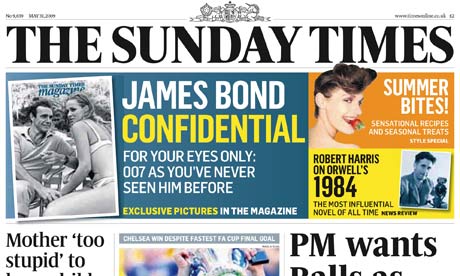
SUNDAY TIMES RETRACTS EXTREMIST SLUR AGAINST ENGLISH DEMOCRATS


SUNDAY TIMES RETRACTS EXTREMIST SLUR AGAINST ENGLISH DEMOCRATS

On Sunday, 20th January 2013 the Sunday Times published in its corrections and clarifications column on page 24 as follows:-
"A story on the election of police and crime commissioners (Party plodders turn police vote into a flop, November 11, 2012) wrongly referred to the English Democrats as an 'extremist' party. The English Democrats are a nationalist party campaigning, among other things, for an English parliament.”

And on its website it also published a correction as follows:-
“An earlier version of this article wrongly referred to the English Democrats as an 'extremist' party. It is a nationalist party."

These corrections followed on from a complaint to the Sunday Times and thereafter to the Press Complaints Commission. The correspondence is set out below. The results do show that proper, reasoned complaining and challenging of media inaccuracy can produce worthwhile results.

Here is the correspondence:-
From: RobinTilbrook@aol.com
To: john.witherow@sunday-times.co.uk, james.harding@thetimes.co.uk, home.news@thetimes.co.uk
BCC: johnhayterengdem@aol.com
Sent: 11/11/2012 19:18:25 GMT Standard Time
Subj: Your offences - Section 61 of the Police and Crime Commissioner Elections Order

Dear Sir
We act for Mr Steven Uncles, Mr David Allen, Mr Stephen Goldspink, Mr Paul Rimmer and Mr Robin Tilbrook who are the English Democrats' candidates for the Police Commissioner elections in Kent, South Yorkshire, Cambridgeshire, Merseyside and Essex respectively.

As you may be aware, pursuant to Section 61 of the Police and Crime Commissioner Elections Order 2012, you are “guilty of an illegal practice” if during this election and for the purpose of affecting the election of any candidate as Police and Crime Commissioner you make or publish any false statement of fact in relation to the candidates personal character or conduct.

Contrary to Section 61 this Sunday the Sunday Times has on page 11 published an Article by James Gillespie and Georgia Graham headed " Party plodders turn police vote into a flop" in which you have published the following statement about the above candidates:- "The figures show that 134 of the candidates are representatives of the political parties - among them five from the extremist right-wing English Democrats".It is a false statement of fact that the English Democrats are "extremist right-wing".

You have also gratuitously made disobliging and disingenuous partisan remarks about their candidacies.

In the circumstances we write to request a full right of reply for our clients to be published in an issue of your daily paper before Thursday's election.

Please confirm your agreement to the above within the next 48 hours failing which we shall advise our clients on whether to proceed by way of criminal prosecutions or to seek a High Court Injunction against you.

Yours faithfully

Tilbrook’s


In a message dated 13/11/2012 15:02:56 GMT Standard Time, pia.sarma@newsint.co.uk writes:
Dear Mr Tilbrook,

Your email to the Editor of The Sunday Times which published the article you refer to, has been passed to me for response.

The Sunday Times and The Times are entirely separate publications with separate editors. A request for a right of reply arising from one publication cannot be considered by a separate publication. For that reason your request for a right of reply in the daily paper is not something which can be met in any event.

I do intend to respond to you in full but as this has only just been brought to my attention, I will do so by the end of tomorrow.

Yours sincerely,
Pia Sarma.


---------------------------------------
Editorial Legal Director
Legal Department- 4th floor
Times Newspapers Limited


From: RobinTilbrook@aol.com
To: pia.sarma@newsint.co.uk
Sent: 14/11/2012 01:02:40 GMT Standard Time
Subj: Re: Your offences - Section 61 of the Police and Crime Commissioner Elections...

Dear Ms Sarma
Thank you but please note they are the same ownership and the same email address

Robin Tilbrook


From: donna.boultwood@newsint.co.uk
To: robintilbrook@aol.com
CC: pia.sarma@newsint.co.uk
Sent: 15/11/2012 16:45:50 GMT Standard Time
Subj: Times Newspapers Limited

Dear Mr Tilbrook

Please see the attached letter sent on behalf of Pia Sarma.

Yours sincerely, Donna Boultwood
P.A. TNL Legal Department
Times Newspapers Limited


Letter from Times Newspapers Limited dated 15th November 2012

Dear Tilbrook

Re: “Party plodders turn police vote into a flop”, The Sunday Times, November 11

Thank you for your letter to the Editors of The Sunday Times and The Times, concerning the above article.

You appear to ask for a right to reply on the basis that publication of the Article was an offence under section 61 of the Police and Crime Commissioner Elections Order 2012.

The statutory instrument creates an offence if anyone makes or publishes any false statement of fact in relation to an election candidate’s personal character or conduct before or during an election and which was for the purpose of affecting the election of that candidate. If the maker of the statement can show that he has reasonable grounds for believing the statement to be true, there is no offence.

I do not agree that the offence has been made out. Firstly, describing the English Democrats as “extremist right-wing” was not necessarily a statement of fact. A statement about the political leanings of candidates is often a matter of opinion. Even if the statement were found to be fact, it is not one which related to any of the candidates personal character or conduct, as is required for an offence to be made out, but rather to political or public role in the party. A Court would also be required to take into account freedom of expression and Article 10 of the European Court of Human Rights in examining the value judgment of the statement. Where any statement does not substantially relate to personal conduct, it may be inconsistent with Article 10 for the Court to find that s.61 would apply, as a recent case held.

It also would not be shown that the statement was made for the purpose of affecting the election of any candidates. Indeed, had that been the intention, each of the candidates would have been named to draw the attention of any potential voter. The article points out that the expected turn-out was anticipated to be disappointingly low, which highlights the need for any article whose purpose was to affect election to be quite specific about its intention in order to capture a potential voter. Finally, the defence of reasonable belief in the truth of the statement may be made out. In summary, the elements of the offence were not met.

As I stated in my email to you, The Times does not carry letters or comment by way of right of reply in relation to articles published in The Sunday Times. However, if you wish to submit a letter to be considered for publication in The Sunday Times, please send it to letters@sunday-times.co.uk, copied to me.

Yours sincerely


Pia Sarma
Editorial Legal Director


Letter 6th December 2012
Press Complaints Commission
Halton House
20/23 Holborn
London
EC1N 2JD


Dear Sir

Re: Sunday Times Article 11th November 2012 by James Gillespie and Georgai Graham: “Party plodders turn police vote into a flop”

This article wrongly asserts that the English Democrats are “Extremist Right-wing”. This comment is inaccurate and untrue. The significance of this unjustified attack taking place in the midst of elections for Police Commissioners makes this matter one of importance.

Immediately this article came to my attention, on the 11th November, I requested the right of reply to this spurious allegation. The response is inadequate and it is obvious that the offending comment is put as a statement of fact not opinion (within the usual meaning given both by the law of defamation and of common sense).

"Extremist right-wing" connotes fascism, racism, Nazism, white supremacy etc., and infers that the English Democrats candidates share those views. It thus clearly relates to our candidates' personal character or conduct. In the context of the article, its timing, and the absence of defamatory comments about any other candidates an inference can be drawn of the improper purpose of affecting the election of our candidates.

This may actually have mattered given that we were not far off getting our candidate elected in South Yorkshire.

I respectfully suggest that the Times would be hard pressed to support any defence of reasonable belief in the truth of the statement. There is no suggestion anywhere that we are a racist party, nor indeed have they made any effort to find out what we do stand for.

No effort was made to speak to anyone from the English Democrats about this allegation either prior to making it or indeed at all.

Not only do James Gillespie’s and Georgia Graham’s professional standards appear to be very sloppy, but also, I would respectfully submit, they breach the Press Complaints Commissions Editor’s Code by failing to maintain the “highest professional standards”. The comments are frankly inaccurate and misleading and no correction has been published.

Rather than accurately reporting the Sunday Times seems to have stooped to smear and innuendo against the English Democrats.

It may also be that the smear derives from an anti-English discriminatory attitude within the Sunday Times and also of these two journalists both of whom bear Scottish surnames.

In the circumstances I wish formally, and on behalf of myself and the other candidates so smeared and the English Democrats, to complain against the Sunday Times.

Yours faithfully

R C W Tilbrook
Chairman

In a message dated 12/12/2012 15:56:57 GMT Standard Time, simon.yip@pcc.org.uk writes:
Dear Mr Tilbrook

Thank you for your email.

Before we can assess your complaint fully, it would be helpful if you could indicate which Clause or Clauses of the Code of Practice you believe have been breached.

We would be very grateful to receive this information within the next ten days.

A copy of the Code of Practice which all newspapers and magazines who subscribe adhere to, can be accessed using this web link: http://www.pcc.org.uk/cop/practice.html

Do not hesitate to contact us if you need further advice. When you write to us, please quote our reference number on this email.

Yours sincerely


Sent on behalf of Simon Yip
Complaints Coordinator
Press Complaints Commission


From: RobinTilbrook@aol.com
To: simon.yip@pcc.org.uk
Sent: 26/12/2012 15:59:05 GMT Standard Time
Subj: Re: Press Complaints Commission - Our reference 125459

Dear Mr Yip,
Thank you for your email. I am sorry not to have responded sooner.
I had used the key phrases from clauses 1,2 and 12 deliberately as these the ones called into play here.
I attach the text of my complaint again for ease of reference.
Yours sincerely

Robin Tilbrook,


In a message dated 03/01/2013 10:09:02 GMT Standard Time, elizabeth.cobbe@pcc.org.uk writes:

Our reference: 125459


Dear Mr Tilbrook

Thank you for your recent correspondence.

I will be dealing with your complaint against The Sunday Times before it goes to the Commission for a decision under the terms of the Editors’ Code, and I will keep you informed of the progress of our investigation into this matter.

A copy of your correspondence has been sent to the publication and I will write to you again once I have received its response.

In the meantime, do not hesitate to contact me if you have any concerns or questions.

Yours sincerely


Elizabeth Cobbe
Complaints Officer

Press Complaints Commission


From: RobinTilbrook@aol.com
To: elizabeth.cobbe@pcc.org.uk
Sent: 03/01/2013 10:10:21 GMT Standard Time
Subj: Re: PCC REF 125459

Thank you
Robin Tilbrook


In a message dated 08/01/2013 11:23:00 GMT Standard Time, elizabeth.cobbe@pcc.org.uk writes:
Dear Mr Tilbrook,

I write further to my email of 3 January.

I have now received a response from The Sunday Times, which I have forwarded below.

As you will see, the newspaper has offered to publish the following correction in its Corrections and Clarifications column:

"A story on the election of police and crime commissioners (Party plodders turn police vote into a flop, November 11, 2012) wrongly referred to the English Democrats as an 'extremist' party. It is a nationalist party."

I would be grateful for your thoughts on this proposal, and in particular whether you would be satisfied that this course of action would resolve the complaint to your satisfaction. As you may be aware, an additional benefit of resolving your complaint is that a summary of it – with a wording agreed by you – will be published prominently on the Commission’s website. This will act, importantly, as a public record of your concerns and the remedial action subsequently taken.

I look forward to hearing from you in due course, preferably in the next seven days.


With kind regards


Elizabeth Cobbe
From: Tyrer, Bob
Sent: 08 January 2013 10:21
To: Elizabeth Cobbe
Subject: Re: New complaint - 125692 Tilbrook

Dear Elizabeth,

Thank you for forwarding this complaint to me.

I have researched the English Democrats' website and activities, and I agree that there is no evidence of political extremism in the normally accepted use of the word - implying violence. I would therefore be happy to resolve this complaint with an entry on these lines in our Corrections and Clarifications column: "A story on the election of police and crime commissioners (Party plodders turn police vote into a flop, November 11, 2012) wrongly referred to the English Democrats as an 'extremist' party. It is a nationalist party."

With best wishes,

Bob
Bob Tyrer
Executive Editor


From: RobinTilbrook@aol.com
To: elizabeth.cobbe@pcc.org.uk
Sent: 08/01/2013 12:54:50 GMT Standard Time
Subj: Re: PCC complaint 125692 Tilbrook

Dear Miss Cobbe

Thank you for your email. The suggested wording goes some way towards satisfying me. I suggest that the second short sentence should read:- "In fact the English Democrats are the main English Nationalist Party and are campaigning for an English Parliament"

Yours sincerely

Robin Tilbrook
Chairman,
The English Democrats


In a message dated 08/01/2013 15:37:11 GMT Standard Time, elizabeth.cobbe@pcc.org.uk writes:
Dear Mr Tilbrook,

Thank you for your earlier email.

As you will see from the below response from the newspaper, it has made a final offer to publish the following wording:

"A story on the election of police and crime commissioners (Party plodders turn police vote into a flop, November 11, 2012) wrongly referred to the English Democrats as an 'extremist' party. The English Democrats are a nationalist party campaigning, among other things, for an English parliament."

It has organised for the removal of the word “extremist” from the article which appears on the website of the newspaper and to publish the following footnote to the article:

“An earlier version of this article wrongly referred to the English Democrats as an 'extremist' party. It is a nationalist party."

I look forward to hearing from you as to whether you would like to resolve the complaint on the basis of these steps.


With kind regards


Elizabeth Cobbe


From: Tyrer, Bob
Sent: 08 January 2013 15:24
To: Elizabeth Cobbe
Subject: Re: PCC complaint 125692 Tilbrook

Dear Elizabeth,

Thanks for your reply.

I would be willing to compromise with this wording: "A story on the election of police and crime commissioners (Party plodders turn police vote into a flop, November 11, 2012) wrongly referred to the English Democrats as an 'extremist' party. The English Democrats are a nationalist party campaigning, among other things, for an English parliament."

That is my final offer on the wording. I also agree to remove the word "extremist" from the online article - in fact, I've already asked for it to be removed, as a gesture of good faith - and I would add the footnote you suggest: “An earlier version of this article wrongly referred to the English Democrats as an 'extremist' party. It is a nationalist party."

With best wishes,

Bob

Bob Tyrer
Executive Editor


From: RobinTilbrook@aol.com
To: elizabeth.cobbe@pcc.org.uk
Sent: 14/01/2013 12:02:31 GMT Standard Time
Subj: Re: PCC complaint 125459 Tilbrook

Dear Ms Cobbe

Re: Sunday Times Article - PCC Complaint 125459|

Before final agreement I would like to see a proof of the proposed agreed wording to be published showing its position, size and prominence. Also I would like to see such a proof in relation to the on-line article.

Yours sincerely

Robin Tilbrook
Chairman,
The English Democrats,


From: elizabeth.cobbe@pcc.org.uk
To: robintilbrook@aol.com
Sent: 16/01/2013 10:04:57 GMT Standard Time
Subj: PCC REF 125459

Dear Mr Tilbrook,

Thank you for your email of 14 January.

The newspaper has said that the page on which the corrections and clarifications are published doesn’t go to press until the Saturday night before publication, so providing a proof would not be practical. It has, however, made an assurance that it will appear in the Corrections and Clarifications column. I have attached to this email a pdf of how the column appears on the page from last week’s newspaper. The correction online would appear as a footnote to the article.

The PCC does not require the newspaper to provide a proof of how any statement negotiated by the PCC would appear; it does, however, require the newspaper to confirm prominence. The newspaper has now done this. I would be grateful if you could confirm whether you would like me to ask the newspaper to proceed with publication.

With kind regards


Elizabeth

Elizabeth Cobbe
Complaints Officer
Press Complaints Commission


From: RobinTilbrook@aol.com
To: elizabeth.cobbe@pcc.org.uk
Sent: 17/01/2013 10:12:31 GMT Standard Time
Subj: Re: PCC REF 125459

Dear Miss Cobbe

Thank you for your email and clarification. In that case we will accept what has been agreed. Thank you for your help.

Yours sincerely

Robin Tilbrook
Chairman,
The English Democrats,


From: elizabeth.cobbe@pcc.org.uk
To: RobinTilbrook@aol.com
Sent: 17/01/2013 14:22:22 GMT Standard Time
Subj: PCC REF 125459

Dear Mr Tilbrook,

Thank you for your earlier email.

The agreed footnote has now been added to the online article and the agreed wording will be published in the corrections and clarifications column in this week’s edition of the newspaper.

With kind regards

Elizabeth Cobbe


From: elizabeth.cobbe@pcc.org.uk
To: robintilbrook@aol.com
Sent: 22/01/2013 11:40:17 GMT Standard Time
Subj: PCC REF 125459


Our reference: 125459


Dear Mr Tilbrook

Now that your complaint has been resolved, a short summary of it will soon be available on the Commission’s web site. Unless we hear to the contrary within 7 days, we will assume that you are happy with the summary and are content for the information to be released publicly. This email has also been copied to the publication, which also has 7 days in which to comment on the wording.

The proposed wording, subject to formal approval by the Commission and any comments from the parties, is as follows:

The Sunday Times

Mr Robin Tilbrook, Chairman of the English Democrats Party, complained to the Press Complaints Commission that the newspaper had breached the terms of Clause 1 (Accuracy) of the Editors’ Code of Practice. The complainant said that the article incorrectly described the English Democrats as “extremist right-wing”. There was no evidence that the party was “extremist” or that its politics could be described as “far right”.

The complaint was resolved when the PCC negotiated the publication of the following statement in the newspaper:

"A story on the election of police and crime commissioners (Party plodders turn police vote into a flop, November 11, 2012) wrongly referred to the English Democrats as an 'extremist' party. The English Democrats are a nationalist party campaigning, among other things, for an English parliament."

The newspaper also appended the following statement to the online article:

“An earlier version of this article wrongly referred to the English Democrats as an 'extremist' party. It is a nationalist party." (Cl 1)

If you are dissatisfied with the way in which your complaint has been handled you should write within one month to the Independent Reviewer, whose details can be accessed using this web link:http://www.pcc.org.uk/about/whoswho/independentreview.html

With best wishes


Elizabeth Cobbe
Complaints Officer
Press Complaints Commission


Email sent 25.1.2013


Dear Ms Cobbe

Thank you for your email of the 22nd. I had in fact written to the Press Complaints Commission that the newspaper had breached the terms of Clauses 1, 2 and 12.

I would be grateful if you could make this amendment.

Yours sincerely


R C W Tilbrook

Tuesday, 25 October 2011

Frank Field speaking good sense again


Frank Field speaking good sense both on the EU and also on the English Question.
Have a listen to this - is he an English national treasure?

Click here >>> http://www.youtube.com/watch?feature=player_embedded&v=FjBkLZN151w

The English are ......?


One answer to this perennial question is that of the mid Victorian Prime Minister, Benjamin Disraeli, who said:-
"The people of England are the most enthusiastic in the world".

Another longer but, I think, interesting answer is provided in an edgier Travelbook than the AA one which I quoted yesterday.

“THE ROUGH GUIDE TO ENGLAND” says in its "Introduction to England":-

Like an ageing cabaret star shuffling onto the stage, England really needs no introduction. When even the world’s most remote communities are on first-name terms with its footballers, princes and prime ministers, it’s clear that everyone knows something about this crowded nation, perched on Europe’s western fringe. As a visitor, you can pick your favourite slice of “Englishness” and indulge yourself in a country with a notorious taste for nostalgia. The tales of King Arthur; the works of Shakespeare; the exploits of Drake; the intellect of Johnson; the invention of Brunel; the leadership of Churchill; the cult of Diana – all are endlessly recycled in England, providing a cultural backdrop to an unparalleled range of historic buildings, monuments and landscapes.


Of course, this isn’t anything like the whole story of England. For every tourist who wants to stand outside the gates of Buckingham Palace or visit Stratford-upon-Avon, there’s another who makes a beeline for the latest show at Tate Modern or the cityscape of downtown Manchester. Contemporary England is a deeply conservative place which at the same time has a richly multi-ethnic culture. Famously, fish and chips gave way some years ago to chicken tikka masala as the country’s favourite dish, and while the nation tends to distrust all things European, the English increasingly embrace the continental lifestyle. Enjoy a fried English breakfast or a Devonshire cream tea by all means, but notice the locals at the next-door café-bar tucking into a croissant and a cappuccino.

Ask an English person to define their country in terms of what’s worth seeing and you’re most likely to have your attention drawn to England’s golden rural past. The classic images are found in every brochure – the village green, the duck pond, the country lane and the farmyard. And it’s true that it’s impossible to overstate the bucolic attractions of various English regions, from Cornwall to the Lake District, or the delights they provide – from walkers’ trails and prehistoric stone circles to traditional pubs and obscure festivals. But despite celebrating their rural heritage, the modern-day English have an ambivalent attitude towards “the countryside”. Farming today forms only a tiny proportion of the national income and there’s a real dislocation between the population of the burgeoning towns and suburbs and the small rural communities badly hit by successive crises in English agriculture.

So perhaps the heart of England is found in its towns and cities instead? The shift towards urban living and working has been steady since the Industrial Revolution, and industry – and the Empire it inspired – has provided a framework for much of what you’ll see as you travel around. Virtually every English town bears a mark of former wealth and power, whether it be a magnificent Gothic cathedral financed from a monarch’s treasury, a parish church funded by the tycoons of the medieval wool trade, or a triumphalist civic building raised on the back of the slave and sugar trade. In the south of England you’ll find old dockyards from which the navy patrolled the oceans, while in the north there are the mills that employed entire town populations. England’s museums and galleries – several of them ranking among the world’s finest – are full of treasures trawled from its imperial conquests. And in their grandiose stuccoed terraces and wide esplanades, the old seaside resorts bear testimony to the heyday of English holiday towns, at one time as fashionable as any European spa.

In short, England isn’t just one place, but a perpetual collision of culture, class and race – the product of multiple identities adapting and somehow fitting together. It’s political philosophies and instructions have influenced the most diverse western societies; its idiosyncrasies and prejudices have left their mark across the English-speaking world, and its inventions and creative momentum, from the Industrial Revolution to the Turner Prize, continue to inspire. But the only certainty for visits is that however long you spend in England and however much you see, it still won’t be enough to understand the place.

WHERE TO GO
To begin to get to grips with England, London is the place to start. Nowhere else in the country can match the scope and innovation of the metropolis, a colossal, frenetic city, perhaps not as immediately attractive as its European counterparts, but with so much variety that lack of cash is the only obstacle to a great time. It’s here that you’ll find England’s best spread of nightlife, cultural events, museums, galleries, pubs and restaurants. However each of the other large cities – Birmingham, Bristol, Newcastle, Leeds, Sheffield, Manchester and Liverpool – makes its own claim for historic and cultural diversity and you certainly won’t have a representative view of England’s cities if you venture no further than the capital. It’s in these regional centres that, currently, the most exciting architectural and social developments are taking place, though for many visitors they rank a long way behind ancient cities like Lincoln, York, Salisbury, Durham and Winchester – to name just those with the most celebrated of England’s cathedrals. Most beguiling of all, though, are the long-established villages of England, hundreds of which amount to nothing more than a pub, a shop, a gaggle of cottages and a farmhouse offering bed and breakfast. Devon, Cornwall, the Cotswold and the Yorkshire Dales harbour some especially picturesque specimens, but every county can boast a decent showing of photogenic hamlets. Evidence of England’s pedigree is scattered between its settlements as well. Wherever you’re based, you’re never more than a few miles from a ruined castle, a majestic country house, or a monastery, and in many parts of the country you’ll come across the sites of civilizations that thrived here before England existed as a nation. In the southwest there are remnants of a Celtic culture that elsewhere was all but eradicated by the Romans, and from the south coats to the northern border you can find traces of prehistoric settlers, the most famous being the megalithic circles of Stonehenge and Avebury.

Then of course there’s the English countryside, an extraordinarily diverse terrain from which Constable, Turner, Wordsworth, Emily Bronte and a host of other native luminaries took inspiration. Most dramatic and best known are the moors and uplands – Exmoor, Dartmoor, Bodmin Moor, the North York Moors and the Lake District – each of which has its over-visited spots, though a brisk walk will usually take you out of the throng. Quieter areas are tucked away in every corner of England, from the lush vales of Shropshire near the border with Wales to the flat wetlands of the eastern Fens and the chalk downland of Sussex. It’s a similar story on the coast, where the finest sands and most rugged cliffs have long been discovered, and sizeable resorts have grown to exploit many of the choicest locations. But again, if it’s peace you’re after, you can find it by heading for the exposed strands of Northumberland, the pebbly flat horizons of East Anglia or the crumbling headlands of Dorset.

Fact File
As part of the United Kingdom of Great Britain and Northern Ireland (“the UK”), England is a parliamentary democracy, with Queen Elizabeth II as its head of state. Its traditional industries – fishing, farming, mining engineering, shipbuilding – are all in decline and business today is dominated by banking and finance, the media and technology, steel production, oil and gas and tourism.

Bordered by Scotland to the north and Wales to the west, England is the largest country in Great Britain, occupying an area of 50,085 sq miles (129,720 sq km). The terrain is diverse, from plains to peaks, cliffs to beaches, though the superlatives are all modest on a world scale – the largest lake, Windermere, is 10 miles (16km) long, the highest mountain, Scafell, just 3205ft (978m) above sea level.

The population of approximately 50 million is dense for a country of its size, but settlement is concentrated in the southeast conurbations around London, and in the large industrial cities of the Midlands and the North.

This is one of the world’s most multi-ethnic countries made up largely of Anglo-Saxon, Scots, Welsh and Irish descent, but with sizeable communities from the Caribbean, Africa, the Indian subcontinent, China, Southeast Asia and Eastern Europe.


Understanding English
As a glance at the tabloid newspapers will confirm, England is a nation of overweight, alcopop-swilling, sex – and celebrity – obsessed TV addicts. But it’s also a country of animal loving, tea-drinking, charity donors thriving on irony and Radio 4. It’s a country where accent and vocabulary can stamp a person’s identity like a brand, where a tiny land-owning aristocracy, who in the some cases trace their roots to the Norman Conquest of the eleventh century, still own most of the land. But it’s also a genuine haven for refugees, and a country of immigrants from more than 100 ethnic backgrounds. It’s a nation where commuters suffer overpriced, under-funded public transport services, and where the hearts of many towns – and increasingly their outskirts – consist of identikit retail zones. Yet it’s also a country where individuality and creativity flourish, fuelling a thriving pop culture and producing one of the most dynamic fashion, music and arts scenes to be found anywhere.

Ask any English person to comment on all of this and – assuming you’re not trying to communicate with a stranger in a public place, which in London at least can be seen as tantamount to physical assault – you’ll get an entertaining range of views. Try to make sense of these, and the resulting picture might suggest something akin to a national identity crisis – the people themselves can’t agree on who or what they are.