
WHAT 2020 HAS SHOWN US ABOUT THE BRITISH STATE
It is worth reminding ourselves that 2020 started off with a newly elected Boris Johnson Government enthusiastically making noises that they were a patriotic, libertarian, pro-Brexit Government, that had thrown off the years of Brexit betrayal under the lacklustre (Conservative) Theresa May.
What a difference a year makes!
2020 has revealed Boris Johnson’s Government as a Government that has planned Lockdown whilst misleading people that they were going to show common-sense. Instead of following our Constitution and our Parliamentary traditions they have used deceitful tactics to roll out a raft of highly authoritarian, ministerial diktats which have, without any proper parliamentary debate or democratic mandate, stripped away our rights as citizens. This has all been done under the traditional tyrant’s cry of “Necessity”!
Even Brexit has not been properly honoured. Instead we have what is little more than Brexit In Name Only (BRINO!).
Also far from controlling mass immigration Boris’ Government has been actively persecuting those who have highlighted illegal immigration on boats coming over from France. The British Government has then housed 10,000 or more of them, in 3 and 4 star hotels across England! Far from making any serious attempt to deport them! The Government has also quietly made it easier for migrants to come here who will inevitably immediately claim our Welfare Benefits. They have done this by dropping the minimum income requirement on bringing over a spouse.
The Government is also now demanding the building of 12m houses over English countryside to house all those migrants who have already come here!
All this at a time when the Government’s incompetent handling of Lockdown has crashed our economy and driven the national debt up far beyond what it was after the Second World War!
Turning from politics to the Law, here the transformation of the British State from an ostensible Liberal Democracy into an openly Police State has been as dramatic as what has happened at the political level, but with even less acknowledgement in our dishonest and deceitful Mainstream Media!
The 23rd March came and went with Boris’ dishonest claim that he was locking down the country when he had no power to do so. This was superseded by a raft of Regulations brought under the Public Health (Control of Diseases) Act 1984 after Parliament had been brow-beated into passing the Coronavirus Act 2020 on the basis that it was an emergency (although at nearly 370 pages it is obvious that it had been months in the preparation) but without declaring a “State of Emergency”.
The Civil Contingencies Act 2004 was also side-lined, as that would have meant that Parliament had some supervisory role over what Ministers were up to.
Instead the wholly undemocratic and, on all traditional principles, unlawful approach has been of using a 1984 Act which was primarily about controlling diseased goods and individuals coming in through the docks, instead to Lockdown the whole of England (N.B. the British Government does not have direct authority over Scotland, Wales and Northern Ireland) and thus avoid parliamentary scrutiny.
In England slowly some Judicial Review challenges started to come forward, the most high profile of which is the Simon Dolan case, which has raised over £400,000 as a fighting fund on their Crowd Justice Appeal. The English Democrats also issued a Judicial Review.
Unfortunately the Simon Dolan case only argued that the Regulations were beyond the powers granted in the Act (ultra vires) and that the Regulations were in breach of the rights protected under the European Convention of Human Rights. In the end the Human Rights Act claims failed entirely. This was partly because Simon Dolan is a multi-millionaire who lives in Monaco and therefore wasn’t personally affected by the removal of Human Rights in England.
Also it was because the Government has adopted the tactic of regularly changing the Regulations, so that by the time any case gets to court, the Regulations that are being challenged have long since been overtaken by other newer Regulations. Many of these newer Regulations are remarkably similar to the previous Regulations but not quite identical! They are thus avoiding judicial scrutiny too!
The Simon Dolan case was allowed to be heard by the Court of Appeal. It failed on the ultra vires point which, on the traditional legal analysis, should not have failed, but the Court of Appeal has produced a Judgment which has endorsed the power of Ministers to make fundamental alterations to citizens’ rights without the need to go to Parliament, based entirely on ministerial diktat.
This is a Judgment that would not have been out of place in mid-1930’s Germany, at which time German Judges were confirming that the powers granted to the Reich Chancellor under the Enabling Act meant that he could re-write any law and that it was lawful for him to do so.
It is therefore not inaccurate to say that the Court of Appeal has endorsed a wholly new constitutional understanding of the nature of the British State. It no longer a Parliamentary Liberal Democracy, but instead a Police State, in the traditional definition of a Police State.
This is particularly true when you couple the Dolan Judgment with the way that the police have actually been behaving on the streets.
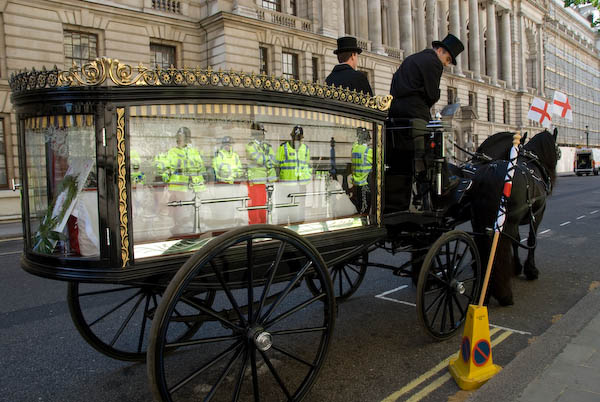
The police have regularly made clear, when they are dealing with any protest that challenges the new order, that they do not care whether what they are doing is legal or illegal. They say that they are focussed on doing is enforcing the orders that they have been given. Police Officers have thus shown themselves to no longer be that traditional English idea of the police as Officers of the Law, but instead they are now merely paramilitary state enforcers, as is vividly reflected by the transformation of their uniforms!
Where does that leave those of us who are not happy with the Globalist, International, Multi-culturalist, Europhile, Authoritarian (but fundamentally incompetent) British Political Establishment?
Well firstly there are still legal challenges going on. The English Democrats’ Judicial Review challenge was over the original Lockdown Regulations and as the Dolan case was proceeding to hearing in the Court of Appeal, the High Court didn’t give us permission to proceed even though we did have the good additional points of pointing out that what was being done was unconstitutional, which had been missed by Simon Dolan’s lawyers.
Our Party’s National Secretary and Greater Manchester Mayoral Candidate, Stephen Morris, together with other Lockdown sceptic activists have continued the challenge by issuing a further Judicial Review dealing both with the more up to date Regulations and also raising the constitutional arguments. We need to bring all these arguments to court to give the courts the final chance to redeem themselves and to uphold our constitution.
Given that, since Tony Blair’s Government, you cannot become a judge without having to “demonstrate a life time’s commitment to Equality and Diversity”, it maybe that this will not succeed, but it would be wrong of us not to try to use purely legal means to challenge the authoritarianism of this Government.
Many people ask me what other options are available for us. One of the ways in which the Government has been trying to enforce Lockdown is by way of fixed penalties by the police.
If you are not fully observing whatever the current Rules are regarding Lockdown in your area, then they can demand your name and address. You are required to do so and, if you do not, they can then arrest you.
I have noticed that there are some people who are falsely claiming that the “Common Law” allows them to refuse to give their name and address. This is simply nonsense. What in fact you are triggering is Section 25 of the Police Criminal Evidence Act which gives the police the right to arrest you. Instead what should be used is Option 2 of the fixed penalty notice, which is to take it to court.
In 1942 the Kent miners, of the Betteshauger Colliery used this tactic very effectively.
Here is what the Dover Museum website has to say about this:-
“Betteshanger was the only pit to strike during the Second World War. The colliers reason for striking was over allowances for working a difficult seam because the conditions changed from week to week. This resulted in three union officials being imprisoned and over 1000 men being given the option of a fine or hard labour. The authorities were keen to suppress the strike: there was a danger that it could spread to other mines and the Government could not afford such a strike in the middle of a war. All but nine of the miners refused to pay. In the face of having to find prison spaces for 1000 men, the government decided to take no action and released the three imprisoned officials”
Here is a link to their website>>>
https://www.dovermuseum.co.uk/Exhibitions/Coal-Mining-in-Kent/History/Betteshanger-Colliery.aspx
It is also worth reminding ourselves about what Ghandi’s tactics on civil disobedience which were outstandingly successful at undermining the greatest Empire that ever existed! Here is some interesting comments about that:-
“How to Fight Back, the Gandhi Way
Wondering what we can do, now that we’re facing the prospect of being in lockdown in all but name until Easter? Professor Ramesh Thakur, a former Assistant Secretary-General of the United Nations and a long-standing sceptic who’s written numerous articles attacking lockdowns, has a suggestion: take a leaf out of Gandhi’s book. As Professor Thakur points out, there is a considerable body of scholarship that shows nonviolent protest – civil disobedience – is more politically effective than violent protest, with the road to Indian independence being a case in point.
But Professor Thakur has a particular form of civil disobedience in mind, one perfected by Gandhi and still used in India to this day. Here’s the gist of it:
‘Jail Bharo Andolan’ is one technique of civil disobedience. It literally means ‘Fill the prisons movement/agitation’. It’s a deliberate, coordinated campaign to subvert a law or regime by courting arrest and imprisonment in numbers that physically clog the courts and overwhelm the prisons. The fact that those imprisoned are normally law-abiding citizens adds greatly to the authorities’ embarrassment…
So to those looking for what you can do: protest peacefully in large numbers, have several rungs of leaders to take the place of any who are arrested, be unfailingly polite and charmingly courteous to police officers and judges, refuse to pay fines in favour of court appearance and trial, and after the court has delivered its verdict go to prison rather than pay fines to overwhelm the prison system until the justice system breaks down.
It requires sacrifice, courage and steadfastness to refuse obedience to the dictates of a discredited and despised government. The dissenters must be prepared to accept the legal consequences, including imprisonment. But if you don’t fight for freedom, get ready to lose it.”
So although the British State may have given itself undemocratic, authoritarian powers over the People of England, but I would say to Boris “who do you think you are kidding Mr Johnson, if you think that old England’s done?” - and we don’t even need a Dad’s Army to fight off this attempt!
We do however need keen supporters and activists to help us fight in the coming elections in May 2021!

